Ch. 7 - DNA Structure and Replication
Sanders - Genetic Analysis: An Integrated Approach 3rd Edition
Sanders3rd EditionGenetic Analysis: An Integrated ApproachISBN: 9780135564172당신이 사용하는 게 아니라요?교과서 변경
7장, 문제 28c

In a dideoxy DNA sequencing experiment, four separate reactions are carried out to provide the replicated material for DNA sequencing gels. Reaction products are usually run in gel lanes labeled A, T, C, and G.
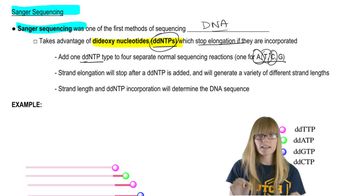
Why is incorporation of a dideoxynucleotide during DNA sequencing identified as a 'replication-terminating' event?

검증된 단계별 안내
1
Understand the structure of dideoxynucleotides (ddNTPs): Unlike regular deoxynucleotides (dNTPs), ddNTPs lack a hydroxyl group (-OH) at the 3' carbon of the sugar. This absence is critical for their role in terminating DNA replication.
Recall the mechanism of DNA synthesis: DNA polymerase adds nucleotides to the growing DNA strand by forming a phosphodiester bond between the 3' hydroxyl group of the last nucleotide and the 5' phosphate group of the incoming nucleotide.
Explain why ddNTPs terminate replication: When a ddNTP is incorporated into the growing DNA strand, the absence of the 3' hydroxyl group prevents the formation of the next phosphodiester bond. This halts further elongation of the DNA strand.
Relate this to the sequencing process: In dideoxy DNA sequencing, the incorporation of ddNTPs at random positions generates DNA fragments of varying lengths. Each fragment ends at the position where a ddNTP was incorporated.
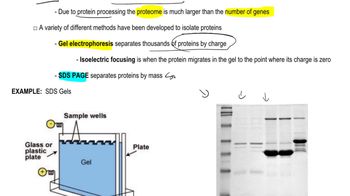
Connect to gel electrophoresis: The DNA fragments are separated by size using gel electrophoresis, and the sequence of the original DNA template can be deduced by analyzing the positions of the fragments in the gel lanes labeled A, T, C, and G.

비슷한 문제에 대한 검증된 영상 답변:

이 영상 해법은 위 문제에 도움이 된다고 튜터들이 추천한 것입니다.
영상 길이:
3m
도움이 되었나요?

주요 개념

질문에 올바르게 답하기 위해 반드시 이해해야 하는 핵심 개념들은 다음과 같습니다.

Dideoxynucleotides

Dideoxynucleotides (ddNTPs) are modified nucleotides used in DNA sequencing that lack a hydroxyl group at the 3' carbon of the sugar. This structural modification prevents the addition of further nucleotides during DNA replication. When a ddNTP is incorporated into a growing DNA strand, it terminates the elongation process, leading to fragments of varying lengths that can be analyzed to determine the DNA sequence.
추천 영상:
가이드 코스
04:12
Sanger Sequencing

Chain Termination

Chain termination is a critical process in DNA sequencing where the incorporation of a dideoxynucleotide halts the synthesis of the DNA strand. This occurs because the absence of the 3' hydroxyl group prevents the formation of the phosphodiester bond necessary for adding additional nucleotides. As a result, each reaction produces DNA fragments that end at different points, allowing for the determination of the sequence based on fragment lengths.
추천 영상:
가이드 코스
01:55
Translation Termination

Gel Electrophoresis

Gel electrophoresis is a laboratory technique used to separate DNA fragments based on their size. In the context of DNA sequencing, the terminated fragments generated from the incorporation of ddNTPs are loaded into a gel matrix and subjected to an electric field. Smaller fragments migrate faster than larger ones, allowing researchers to visualize and analyze the sequence of nucleotides by comparing the positions of the fragments in the gel lanes labeled A, T, C, and G.
추천 영상:
관련 실천
교과서 질문

In a dideoxy DNA sequencing experiment, four separate reactions are carried out to provide the replicated material for DNA sequencing gels. Reaction products are usually run in gel lanes labeled A, T, C, and G.

How does PCR play a role in dideoxy DNA sequencing?

551
views
교과서 질문

The following dideoxy DNA sequencing gel is produced in a laboratory.

What is the double-stranded DNA sequence of this molecule? Label the polarity of each strand.

787
views
교과서 질문

A PCR reaction begins with one double-stranded segment of DNA. How many double-stranded copies of DNA are present after the completion of 10 amplification cycles? After 20 cycles? After 30 cycles?

564
views
교과서 질문

A family consisting of a mother (I-1), a father (I-2), and three children (II-1, II-2, and II-3) are genotyped by PCR for a region of an autosome containing repeats of a 10-bp sequence. The mother carries 16 repeats on one chromosome and 21 on the homologous chromosome. The father carries repeat numbers of 18 and 26.

What genetic term best describes the pattern of inheritance of this DNA marker? Explain your choice.

597
views
교과서 질문

In a dideoxy DNA sequencing experiment, four separate reactions are carried out to provide the replicated material for DNA sequencing gels. Reaction products are usually run in gel lanes labeled A, T, C, and G.

Identify the nucleotides used in the dideoxy DNA sequencing reaction that produces molecules for the A lane of the sequencing gel.

726
views
교과서 질문

Using an illustration style and labeling, draw the electrophoresis gel containing dideoxy sequencing fragments for the DNA template strand 3'-AGACGATAGCAT-5'.

479
views