
Suppose that future exploration of polar ice on Mars identifies a living microbe and that analysis indicates the organism carries double-stranded DNA as its genetic material. Suppose further that DNA replication analysis is performed by first growing the microbe in a growth medium containing the heavy isotope of nitrogen (¹⁴N) that the organism is then transferred to a growth medium containing the light isotope of nitrogen (¹⁴N) and that the nitrogen composition of the DNA is examined by CsCl ultracentrifugation and densitometry after the first, second, and third replication cycles in the ¹⁴N-containing medium. The results of the experiment are illustrated here for each cycle. The control shows the positioning of the three possible DNA densities. Based on the results shown, what can you conclude about the mechanism of DNA replication in this organism?

- Ch. 1 - The Molecular Basis of Heredity, Variation, and Evolution64
- Ch. 2 - Transmission Genetics144
- Ch. 3 - Cell Division and Chromosome Heredity81
- Ch. 4 - Gene Interaction87
- Ch. 5 - Genetic Linkage and Mapping in Eukaryotes103
- Ch. 6 - Genetic Analysis and Mapping in Bacteria and Bacteriophages73
- Ch. 7 - DNA Structure and Replication71
- Ch. 8 - Molecular Biology of Transcription and RNA Processing79
- Ch. 9 - The Molecular Biology of Translation110
- Ch. 10 - Eukaryotic Chromosome Abnormalities and Molecular Organization100
- Ch. 11 - Gene Mutation, DNA Repair, and Homologous Recombination86
- Ch. 12 - Regulation of Gene Expression in Bacteria and Bacteriophage90
- Ch. 13 - Regulation of Gene Expression in Eukaryotes38
- Ch. 14 - Analysis of Gene Function via Forward Genetics and Reverse Genetics72
- Ch. 15 - Recombinant DNA Technology and Its Applications69
- Ch. 16 - Genomics: Genetics from a Whole-Genome Perspective49
- Ch. 17 - Organelle Inheritance and the Evolution of Organelle Genomes27
- Ch. 18 - Developmental Genetics43
- Ch. 19 - Genetic Analysis of Quantitative Traits66
- Ch. 20 - Population Genetics and Evolution at the Population, Species, and Molecular Levels105
You are participating in a study group preparing for an upcoming genetics exam, and one member of the group proposes that each of you draw the structure of two DNA nucleotides joined in a single strand. The figures are drawn and exchanged for correction. You receive the accompanying diagram to correct: What is wrong with the way the nucleotides are joined?
 검증된 단계별 안내
비슷한 문제에 대한 검증된 영상 답변:

주요 개념
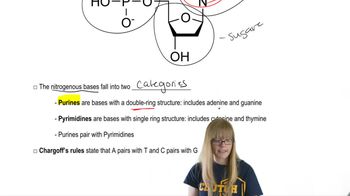
DNA Nucleotide Structure
 06:25
06:25
Phosphodiester Bond
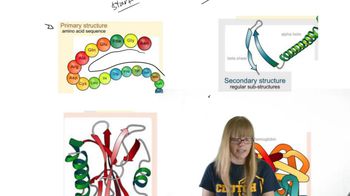
06:25Antiparallel Orientation
 05:05
05:05What would be the effects on DNA replication if mutation of DNA pol III caused it to lose each of the following activities?
3′ to 5′ exonuclease activity
The following diagram shows the parental strands of a DNA molecule undergoing replication.
Draw the daughter strands present in the replication bubble, indicating:
a. The polarity of daughter strands
b. The leading and lagging strands
c. Okazaki fragments
d. The locations of RNA primers
You are participating in a study group preparing for an upcoming genetics exam, and one member of the group proposes that each of you draw the structure of two DNA nucleotides joined in a single strand. The figures are drawn and exchanged for correction. You receive the accompanying diagram to correct: Draw this single-stranded segment correctly.
You are participating in a study group preparing for an upcoming genetics exam, and one member of the group proposes that each of you draw the structure of two DNA nucleotides joined in a single strand. The figures are drawn and exchanged for correction. You receive the accompanying diagram to correct: Identify and correct at least five things that are wrong in the depiction of each nucleotide.
A sufficient amount of a small DNA fragment is available for dideoxy sequencing. The fragment to be sequenced contains 20 nucleotides following the site of primer binding: 5'-ATCGCTCGACAGTGACTAGC-[primer site]-3' Dideoxy sequencing is carried out, and the products of the four sequencing reactions are separated by gel electrophoresis. Draw the bands you expect will appear on the gel from each of the sequencing reactions.