Ch. 8 - Molecular Biology of Transcription and RNA Processing
Sanders - Genetic Analysis: An Integrated Approach 3rd Edition
Sanders3rd EditionGenetic Analysis: An Integrated ApproachISBN: 9780135564172당신이 사용하는 게 아니라요?교과서 변경
8장, 문제 31b

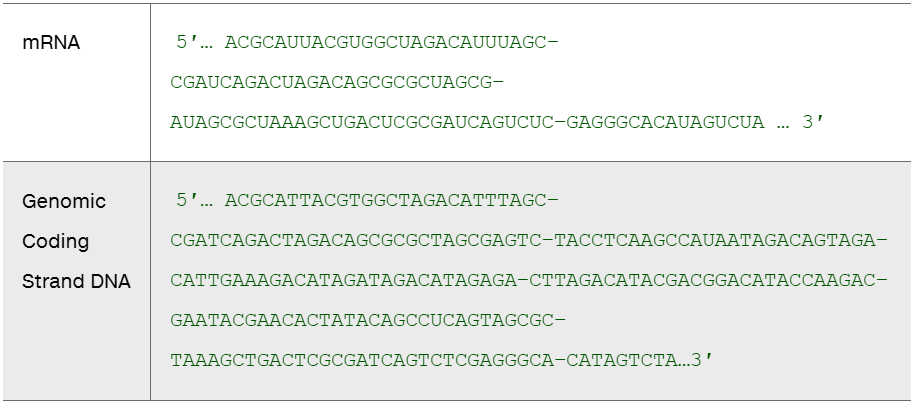
A portion of a human gene is isolated from the genome and sequenced. The corresponding segment of mRNA is isolated from the cytoplasm of human cells, and it is also sequenced. The nucleic acid strings shown here are from genomic coding strand DNA and the corresponding mRNA.

Does this intron contain normal splice-site sequences?

검증된 단계별 안내
1
Step 1: Understand the problem. The question asks whether the intron in the genomic DNA contains normal splice-site sequences. Splice sites are specific sequences at the boundaries of introns and exons that are recognized by the spliceosome during RNA splicing. The canonical splice-site sequences are typically 'GU' at the 5' end of the intron and 'AG' at the 3' end of the intron.
Step 2: Identify the intron region in the genomic DNA sequence. Introns are non-coding regions that are removed during RNA splicing. Compare the genomic DNA sequence with the mRNA sequence to locate the intron, as the mRNA sequence will only contain exons (coding regions).
Step 3: Examine the 5' and 3' ends of the intron in the genomic DNA sequence. Look for the presence of the canonical splice-site sequences ('GU' at the 5' end and 'AG' at the 3' end). These sequences are critical for proper splicing.
Step 4: Analyze the surrounding sequences for additional splice-site consensus motifs. Besides the 'GU' and 'AG' sequences, other conserved regions such as the branch point (usually an 'A' located upstream of the 3' splice site) and polypyrimidine tract (a sequence rich in pyrimidines near the 3' splice site) should also be checked.
Step 5: Conclude whether the intron contains normal splice-site sequences based on the analysis. If the canonical 'GU' and 'AG' sequences, along with other conserved motifs, are present, the intron likely contains normal splice-site sequences. If these sequences are absent or mutated, splicing may be impaired.

비슷한 문제에 대한 검증된 영상 답변:

이 영상 해법은 위 문제에 도움이 된다고 튜터들이 추천한 것입니다.
영상 길이:
2m

주요 개념

질문에 올바르게 답하기 위해 반드시 이해해야 하는 핵심 개념들은 다음과 같습니다.

Introns and Exons

Introns are non-coding sequences of DNA that are transcribed into pre-mRNA but are removed during RNA splicing. Exons, on the other hand, are the coding sequences that remain in the mature mRNA and are translated into proteins. Understanding the distinction between introns and exons is crucial for analyzing gene structure and function.
추천 영상:
가이드 코스
08:39
mRNA Processing

Splice Sites

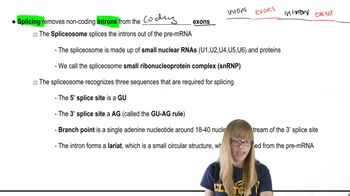
Splice sites are specific nucleotide sequences at the boundaries of introns and exons that signal where splicing should occur. The consensus sequences at these sites, typically found at the 5' and 3' ends of introns, are recognized by the spliceosome, the complex responsible for removing introns from pre-mRNA. Identifying these sequences is essential for determining if an intron contains normal splice-site sequences.
추천 영상:
가이드 코스
08:39
mRNA Processing

RNA Splicing

RNA splicing is the process by which introns are removed from pre-mRNA and exons are joined together to form mature mRNA. This process is vital for the correct expression of genes, as it ensures that only the coding regions are translated into proteins. Analyzing the splicing process helps in understanding gene regulation and the potential impact of mutations on protein synthesis.
추천 영상: