Ch. 8 - Molecular Biology of Transcription and RNA Processing
Sanders - Genetic Analysis: An Integrated Approach 3rd Edition
Sanders3rd EditionGenetic Analysis: An Integrated ApproachISBN: 9780135564172당신이 사용하는 게 아니라요?교과서 변경
8장, 문제 4a

The diagram below shows a DNA duplex. The template strand is identified, as is the location of the nucleotide.
Diagram of a DNA duplex showing the template and coding strands, with promoter and termination sequences indicated.
Assume this region contains a gene transcribed in a bacterium. Identify the location of promoter consensus sequences and of the transcription termination sequence.

검증된 단계별 안내
1
Examine the DNA duplex diagram to identify the template strand and the direction of transcription (5' to 3' on the coding strand, 3' to 5' on the template strand).
Locate the promoter region upstream of the gene. In bacteria, the promoter typically contains two consensus sequences: the -10 sequence (TATAAT) and the -35 sequence (TTGACA). These sequences are recognized by RNA polymerase and sigma factors.
Mark the -10 and -35 consensus sequences on the template strand, ensuring they are positioned correctly relative to the transcription start site (+1).
Identify the transcription termination sequence downstream of the gene. In bacteria, termination can occur via two mechanisms: Rho-dependent termination or intrinsic (Rho-independent) termination. For intrinsic termination, look for a GC-rich region followed by a series of uracils (poly-U) in the RNA transcript.
Label the termination sequence on the DNA duplex, ensuring it corresponds to the appropriate mechanism (e.g., intrinsic termination structure or Rho-binding site).

비슷한 문제에 대한 검증된 영상 답변:

이 영상 해법은 위 문제에 도움이 된다고 튜터들이 추천한 것입니다.
영상 길이:
3m

주요 개념

질문에 올바르게 답하기 위해 반드시 이해해야 하는 핵심 개념들은 다음과 같습니다.

Promoter Consensus Sequences

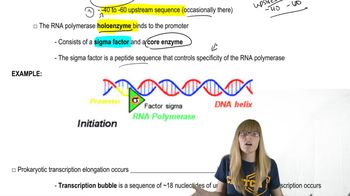
Promoter consensus sequences are specific DNA sequences located upstream of a gene that signal the start of transcription. In bacteria, these sequences are recognized by RNA polymerase and associated transcription factors, facilitating the binding of the enzyme to initiate RNA synthesis. Common elements include the -10 (Pribnow box) and -35 regions, which are crucial for the proper recognition and binding of the transcription machinery.
추천 영상:
가이드 코스
08:55
Sequencing Overview

Transcription Termination Sequence

The transcription termination sequence is a specific region of DNA that signals the end of transcription. In bacteria, this sequence often contains a palindromic structure that forms a hairpin loop in the RNA transcript, followed by a series of uracil nucleotides. This structure destabilizes the RNA polymerase's interaction with the DNA, leading to the release of the newly synthesized RNA molecule.
추천 영상:
가이드 코스
10:14
Prokaryotic Transcription

DNA Duplex Structure

The DNA duplex structure refers to the double-helix formation of DNA, consisting of two complementary strands held together by base pairs. Each strand has a directionality, with a 5' end and a 3' end, which is crucial for processes like replication and transcription. Understanding this structure is essential for identifying the template strand and the orientation of genes within the DNA molecule.
추천 영상: