 뒤로
뒤로Comprehensive Study Guide for Metabolism and Biochemical Pathways in GOB Chemistry
스터디 가이드 - 스마트 노트
 자료에 맞춘 맞춤형 노트, 핵심 정의, 예시, 맥락을 확장해 제공합니다.
Q1. What is anabolism?
Background
Topic: Metabolism – Anabolism
This question tests your understanding of the two main types of metabolic pathways: anabolism and catabolism. Anabolism refers to the set of metabolic pathways that construct molecules from smaller units.
Key Terms:
Anabolism: The biosynthetic phase of metabolism, where smaller molecules are built up into larger, more complex molecules.
Step-by-Step Guidance
Recall that metabolism is divided into two main categories: anabolism and catabolism.
Think about the processes in the body that require energy input to build complex molecules (e.g., protein synthesis, DNA replication).
Consider the role of ATP in providing energy for these biosynthetic reactions.
Try solving on your own before revealing the answer!
Final Answer:
Anabolism is the set of metabolic pathways that construct complex molecules from simpler ones, usually requiring energy input (often from ATP).
Q2. What is catabolism?
Background
Topic: Metabolism – Catabolism
This question is about the breakdown phase of metabolism, where larger molecules are degraded into smaller ones, releasing energy.
Key Terms:
Catabolism: The degradative phase of metabolism, where complex molecules are broken down into simpler ones, releasing energy.
Step-by-Step Guidance
Recall that catabolism is the opposite of anabolism.
Think about examples of catabolic processes (e.g., glycolysis, fatty acid oxidation).
Consider how catabolic reactions release energy, often captured in the form of ATP or reduced coenzymes (NADH, FADH2).
Try solving on your own before revealing the answer!
Final Answer:
Catabolism is the set of metabolic pathways that break down complex molecules into simpler ones, releasing energy that can be used to produce ATP.
Q3. Why is ATP such a high energy molecule?
Background
Topic: ATP Structure and Function
This question tests your understanding of why ATP (adenosine triphosphate) is considered the energy currency of the cell.
Key Terms and Concepts:
ATP: Adenosine triphosphate, a molecule that stores and transfers energy in cells.
Phosphoanhydride bonds: The bonds between phosphate groups in ATP, which are high-energy bonds.
Step-by-Step Guidance
Recall the structure of ATP: adenine, ribose, and three phosphate groups.
Think about the repulsion between the negatively charged phosphate groups.
Consider what happens when ATP is hydrolyzed to ADP and inorganic phosphate (Pi).
Reflect on how the energy released from breaking these bonds is used in cellular processes.
Try solving on your own before revealing the answer!
Final Answer:
ATP is a high-energy molecule because its phosphoanhydride bonds (especially the terminal phosphate bond) are unstable due to electrostatic repulsion between phosphate groups. Hydrolysis of ATP releases a large amount of free energy, which can be used to drive cellular processes.
Q4. Write the overall equation for the combined reaction of glucose phosphorylation and ATP hydrolysis including the net energy change.
Background
Topic: Coupled Reactions in Metabolism
This question tests your ability to combine two biochemical reactions and calculate the net energy change.
Key Terms and Formulas:
Glucose phosphorylation:
ATP hydrolysis:
Net reaction: Add the two reactions and sum the energy changes.
Step-by-Step Guidance
Write the equation for glucose phosphorylation and note the energy required (+3.3 kcal/mol).
Write the equation for ATP hydrolysis and note the energy released (−7.3 kcal/mol).
Add the two reactions, canceling out Pi as an intermediate.
Sum the energy changes to find the net energy change for the coupled reaction.
Try solving on your own before revealing the answer!
Final Answer:
The overall equation is:
Net energy change: kcal/mol (−7.3 + 3.3)
This shows that the coupled reaction is energetically favorable.
Q5. What does the structure of NAD+ look like? What types of reactions can NAD+ participate in?
Background
Topic: Coenzymes in Metabolism
This question is about the structure and function of NAD+ (nicotinamide adenine dinucleotide), a key electron carrier in metabolism.
Key Terms:
NAD+: An oxidized coenzyme that accepts electrons during redox reactions.
Redox reactions: Reactions involving the transfer of electrons.
Step-by-Step Guidance
Recall that NAD+ consists of two nucleotides joined through their phosphate groups: one with an adenine base, the other with nicotinamide.
Think about the role of NAD+ in accepting electrons (as a hydride ion, H−) during oxidation reactions.
Consider the types of metabolic pathways where NAD+ is reduced to NADH (e.g., glycolysis, TCA cycle).
Try solving on your own before revealing the answer!
Final Answer:
NAD+ is composed of two nucleotides (adenine and nicotinamide) linked by their phosphate groups. It participates in redox reactions, acting as an electron acceptor in pathways like glycolysis and the citric acid cycle.
Q6. What vitamin is a precursor for NAD+?
Background
Topic: Vitamins as Coenzyme Precursors
This question tests your knowledge of the vitamins required for coenzyme synthesis.
Key Term:
Niacin (Vitamin B3): The vitamin precursor for NAD+.
Step-by-Step Guidance
Recall which B vitamin is converted into NAD+ in the body.
Think about dietary sources of this vitamin and its importance in metabolism.
Try solving on your own before revealing the answer!
Final Answer:
Niacin (Vitamin B3) is the vitamin precursor for NAD+.
Q7. Is NAD+ in an oxidized or reduced state? What is the formula for NAD+ after a redox reaction?
Background
Topic: Redox States of Coenzymes
This question is about recognizing the oxidized and reduced forms of NAD+ and their roles in metabolism.
Key Terms:
Oxidized state: NAD+
Reduced state: NADH
Step-by-Step Guidance
Recall that NAD+ is the oxidized form and accepts electrons to become NADH.
Write the redox reaction:
Identify the formula for the reduced form after the reaction.
Try solving on your own before revealing the answer!
Final Answer:
NAD+ is in the oxidized state. After a redox reaction, it is reduced to NADH.
Q8. What does the structure of FAD look like? What types of reactions can FAD participate in?
Background
Topic: Coenzymes in Metabolism
This question is about the structure and function of FAD (flavin adenine dinucleotide), another important electron carrier.
Key Terms:
FAD: A coenzyme involved in redox reactions, especially in the citric acid cycle and electron transport chain.
Step-by-Step Guidance
Recall that FAD consists of a riboflavin (vitamin B2) moiety linked to an adenine nucleotide.
Think about the types of reactions FAD participates in (e.g., dehydrogenation reactions).
Consider where FAD is reduced to FADH2 in metabolism.
Try solving on your own before revealing the answer!
Final Answer:
FAD is composed of riboflavin and adenine nucleotides. It participates in redox reactions, accepting two electrons and two protons to become FADH2, especially in the citric acid cycle.
Q9. What vitamin is a precursor for FAD?
Background
Topic: Vitamins as Coenzyme Precursors
This question tests your knowledge of the vitamin required for FAD synthesis.
Key Term:
Riboflavin (Vitamin B2): The vitamin precursor for FAD.
Step-by-Step Guidance
Recall which B vitamin is converted into FAD in the body.
Think about the importance of this vitamin in energy metabolism.
Try solving on your own before revealing the answer!
Final Answer:
Riboflavin (Vitamin B2) is the vitamin precursor for FAD.
Q10. Is FAD in an oxidized or reduced state? What is the formula for FAD after a redox reaction?
Background
Topic: Redox States of Coenzymes
This question is about recognizing the oxidized and reduced forms of FAD and their roles in metabolism.
Key Terms:
Oxidized state: FAD
Reduced state: FADH2
Step-by-Step Guidance
Recall that FAD is the oxidized form and accepts two electrons and two protons to become FADH2.
Write the redox reaction:
Identify the formula for the reduced form after the reaction.
Try solving on your own before revealing the answer!
Final Answer:
FAD is in the oxidized state. After a redox reaction, it is reduced to FADH2.
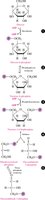
Q11. Label each step of glycolysis with the type of reaction that is taking place.
Background
Topic: Glycolysis – Reaction Types
This question asks you to identify the type of chemical reaction occurring at each step of glycolysis. Understanding these helps you see how glucose is converted to pyruvate.
Key Terms:
Phosphorylation: Addition of a phosphate group.
Isomerization: Rearrangement of atoms within a molecule.
Cleavage: Splitting of a molecule into two smaller molecules.
Dehydrogenation: Removal of hydrogen atoms (oxidation).
Substrate-level phosphorylation: Direct transfer of a phosphate group to ADP to form ATP.
Step-by-Step Guidance
Review the glycolysis pathway and identify the enzyme for each step.
For each step, determine if it is a phosphorylation, isomerization, cleavage, oxidation, or substrate-level phosphorylation.
Use the provided diagram to match each reaction with its type.
Try solving on your own before revealing the answer!
Final Answer:
Each step of glycolysis can be labeled as follows (using the diagram):
Step 1: Phosphorylation
Step 2: Isomerization
Step 3: Phosphorylation
Step 4: Cleavage
Step 5: Isomerization
Continue this process for the energy-generating steps (see next question).
Q12. Label each step of the last 5 reactions in glycolysis with the type of reaction that is taking place.
Background
Topic: Glycolysis – Energy-Generating Reactions
This question focuses on the second half of glycolysis, where ATP and NADH are produced.
Key Terms:
Oxidation: Loss of electrons (often as hydrogen atoms).
Phosphorylation: Addition of a phosphate group.
Dehydration: Removal of water.
Substrate-level phosphorylation: Direct formation of ATP from ADP and a phosphorylated substrate.
Step-by-Step Guidance
Review the last five steps of glycolysis using the provided diagram.
Identify the enzyme and reaction type for each step (e.g., oxidation, phosphorylation, dehydration, substrate-level phosphorylation).
Label each step accordingly.

Try solving on your own before revealing the answer!
Final Answer:
The last five steps of glycolysis are:
Step 6: Oxidation and phosphorylation
Step 7: Substrate-level phosphorylation
Step 8: Isomerization
Step 9: Dehydration
Step 10: Substrate-level phosphorylation
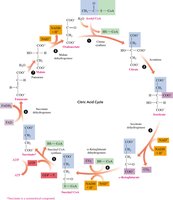
Q13. Label each step of the citric acid cycle with the type of reaction that is taking place.
Background
Topic: Citric Acid Cycle – Reaction Types
This question asks you to identify the type of chemical reaction at each step of the citric acid cycle (Krebs cycle).
Key Terms:
Condensation: Joining of two molecules with the loss of a small molecule (often water).
Isomerization: Rearrangement of atoms within a molecule.
Oxidative decarboxylation: Removal of a carboxyl group as CO2 with oxidation.
Substrate-level phosphorylation: Formation of GTP or ATP from GDP or ADP.
Hydration: Addition of water.
Step-by-Step Guidance
Review the citric acid cycle diagram and identify the enzyme for each step.
For each step, determine if it is a condensation, isomerization, oxidative decarboxylation, substrate-level phosphorylation, or hydration reaction.
Label each step accordingly using the diagram.
Try solving on your own before revealing the answer!
Final Answer:
The steps of the citric acid cycle are labeled as follows:
Step 1: Condensation
Step 2: Isomerization
Step 3: Oxidative decarboxylation
Step 4: Oxidative decarboxylation
Step 5: Substrate-level phosphorylation
Step 6: Oxidation
Step 7: Hydration
Step 8: Oxidation
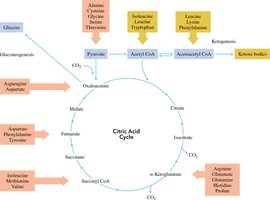
Q14. Label the ketogenic and glucogenic amino acids.
Background
Topic: Amino Acid Metabolism
This question is about classifying amino acids based on whether their carbon skeletons can be converted to glucose (glucogenic) or ketone bodies (ketogenic).
Key Terms:
Glucogenic amino acids: Amino acids whose carbon skeletons can be converted to glucose via gluconeogenesis.
Ketogenic amino acids: Amino acids whose carbon skeletons are converted to acetyl-CoA or acetoacetate, leading to ketone body formation.
Step-by-Step Guidance
Review the metabolic fates of amino acids using the provided diagram.
Identify which amino acids are exclusively glucogenic, exclusively ketogenic, or both.
Label each amino acid accordingly on the diagram.
Try solving on your own before revealing the answer!
Final Answer:
Glucogenic amino acids: Most amino acids (e.g., alanine, glycine, serine, aspartate, glutamate, etc.)
Ketogenic amino acids: Leucine and lysine (exclusively), and some (isoleucine, phenylalanine, tryptophan, tyrosine) are both ketogenic and glucogenic.
