 뒤로
뒤로Dilution and Properties of Solutions (GOB Chemistry Chapter 9.5–9.6 Study Notes)
스터디 가이드 - 스마트 노트
 자료에 맞춘 맞춤형 노트, 핵심 정의, 예시, 맥락을 확장해 제공합니다.
Dilution of Solutions
Understanding Dilution
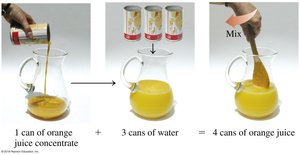
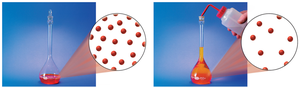
When preparing solutions in the laboratory or in everyday life, it is common to dilute a concentrated solution by adding more solvent, usually water. This process increases the total volume of the solution while decreasing its concentration. Importantly, the amount of solute remains unchanged during dilution.
Dilution involves adding solvent to a solution, increasing its volume and decreasing its concentration.
The mass of solute stays the same before and after dilution.
Common example: Making orange juice from concentrate by adding water.
Dilution Calculations
The relationship between the initial and final concentrations and volumes of a solution is given by the dilution equation:
Formula:
C1 = initial concentration
V1 = initial volume
C2 = final concentration
V2 = final volume
This equation can be rearranged to solve for any unknown (concentration or volume) after dilution.
Example: If 0.50 L of 6.0 M HCl is diluted to 1.0 L, the final concentration is:
Properties of Solutions
Characteristics of Solutions
Solutions are homogeneous mixtures composed of a solute dissolved in a solvent. They have unique properties that distinguish them from other types of mixtures.
Solutions are transparent and do not scatter light.
They do not separate upon standing.
Contain very small particles (ions or molecules) that cannot be filtered out and can pass through semipermeable membranes.
Colloids and Suspensions
Mixtures can be classified based on the size of their particles:
Colloids: Medium-sized particles, cannot be filtered, but can be separated by semipermeable membranes. Examples: fog, shaving cream, blood plasma.
Suspensions: Large particles, heterogeneous and nonuniform, can be filtered, and particles settle out unless stirred. Examples: muddy water, calamine lotion.
Comparison Table:
Type | Particle Size | Filtration | Membrane Separation | Examples |
|---|---|---|---|---|
Solution | Small (ions/molecules) | No | No | Salt water, sugar water |
Colloid | Medium | No | Yes | Milk, fog, blood plasma |
Suspension | Large | Yes | Yes | Muddy water, calamine lotion |
Osmosis and Osmotic Pressure
Osmosis
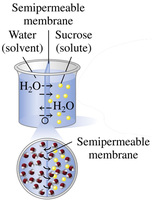
Osmosis is the movement of water (solvent) through a semipermeable membrane from a region of lower solute concentration to a region of higher solute concentration. This process continues until the concentrations on both sides of the membrane are equal.
Water moves to dilute the more concentrated solution.
The level of the solution with higher solute concentration rises.
Osmotic Pressure
Osmotic pressure is the pressure required to prevent the flow of water through a semipermeable membrane. It increases with the number of dissolved particles in the solution.
Higher solute concentration = higher osmotic pressure.
Reverse Osmosis
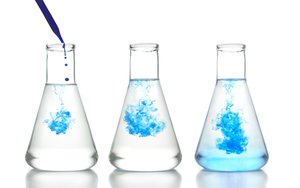
In reverse osmosis, a pressure greater than the osmotic pressure is applied to a solution, forcing water to move in the opposite direction through a purification membrane. This process is used in desalination plants to obtain pure water from seawater.
Requires significant energy input.
Biological Applications: Tonicity
Isotonic Solutions
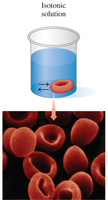
An isotonic solution has the same osmotic pressure as body fluids (e.g., blood plasma). Red blood cells retain their normal shape and volume in isotonic solutions, such as 0.90% NaCl or 5.0% glucose.
Hypertonic and Hypotonic Solutions
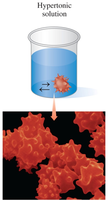
Hypertonic solution: Higher solute concentration than the cell; water leaves the cell, causing it to shrink (crenation).
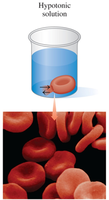
Hypotonic solution: Lower solute concentration than the cell; water enters the cell, causing it to swell and possibly burst (hemolysis).
Dialysis
Principle of Dialysis
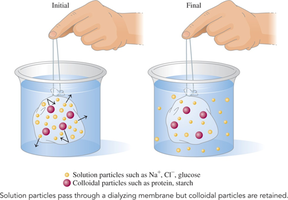
Dialysis is a process where small solute particles and solvent pass through an artificial membrane, while larger particles are retained. This principle is used in medical treatments such as hemodialysis to remove waste products (e.g., urea) from the blood.
Summary Table: Types of Mixtures and Membrane Behavior
Mixture Type | Particle Size | Filtration | Semipermeable Membrane | Examples |
|---|---|---|---|---|
Solution | Small | No | Passes through | Salt water |
Colloid | Medium | No | Retained | Milk |
Suspension | Large | Yes | Retained | Muddy water |
Additional info: These concepts are foundational for understanding solution behavior in chemical and biological systems, including laboratory practices and physiological processes such as fluid balance in cells.
