 뒤로
뒤로GOB Chemistry Study Guide: Carbohydrates, Glucose, and Fructose
스터디 가이드 - 스마트 노트
 자료에 맞춘 맞춤형 노트, 핵심 정의, 예시, 맥락을 확장해 제공합니다.
Q1. Express the molecular formulas of several carbohydrates (C6H12O6, C12H22O11, (C6H10O5)n) in the general form Cn(H2O)m.
Background
Topic: Carbohydrate Chemistry – Empirical and Molecular Formulas
This question tests your understanding of how to write the general formula for carbohydrates and recognize their empirical relationships.
Key Terms and Formulas
Carbohydrate: Organic compounds with the general formula .
Empirical formula: The simplest integer ratio of elements in a compound.
Step-by-Step Guidance
Write the molecular formula for each carbohydrate: glucose (), sucrose (), and starch/cellulose ().
Express each formula in the form by factoring out the ratio of hydrogen to oxygen atoms.
For each, compare the values of and to see if they match the empirical formula.
Set up the general forms for each compound and match them to the answer choices.
Try solving on your own before revealing the answer!
Final Answer: D. , ,
Each formula is rewritten to match the general carbohydrate formula .
Q2. Identify the functional groups present in the open-chain structure of glucose.
Background
Topic: Functional Groups in Carbohydrates
This question tests your ability to recognize functional groups (aldehyde, ketone, hydroxy, carboxylic acid, ether) in glucose.
Key Terms and Formulas
Aldehyde group:
Ketone group: (not at the end of the chain)
Hydroxy group:
Carboxylic acid:
Ether:
Step-by-Step Guidance
Recall the open-chain structure of glucose: .
Identify the functional groups present: look for (aldehyde) and (hydroxy) groups.
Check if there is a ketone group (internal ), carboxylic acid, or ether group in the structure.
Evaluate each statement (a–d) for correctness based on the structure.
Try solving on your own before revealing the answer!
Final Answer:
a: Sai (glucose has an aldehyde, not a ketone)
b: Sai (not only hydroxy groups, also an aldehyde)
c: Đúng (aldehyde and hydroxy groups present)
d: Sai (no carboxylic acid or ether group)
Q3. Analyze statements about the structures and classification of glucose and fructose.
Background
Topic: Monosaccharides – Structure and Isomerism
This question checks your understanding of the differences and similarities between glucose and fructose, including their classification and structural features.
Key Terms and Formulas
Monosaccharide: Simple sugar, cannot be hydrolyzed further.
Disaccharide: Two monosaccharides linked together.
Isomerism: Compounds with the same formula but different structures.
Aldehyde group in glucose, ketone group in fructose.
Step-by-Step Guidance
Recall the open-chain structures: glucose has an aldehyde group, fructose has a ketone group.
Determine if both are monosaccharides and if they are structural or stereoisomers.
Check if either is a disaccharide or polysaccharide.
Evaluate each statement (a–d) for correctness.
Try solving on your own before revealing the answer!
Final Answer:
a: Đúng
b: Sai (they are structural isomers, not just spatial orientation)
c: Sai (they are monosaccharides, not disaccharides)
d: Sai (glucose is not a polysaccharide)
Q4. Evaluate statements about the general formula and classification of carbohydrates.
Background
Topic: Carbohydrate Classification and General Formula
This question tests your understanding of the empirical formula and classification of carbohydrates, as well as hydrolysis reactions.
Key Terms and Formulas
General formula:
Monosaccharide: Cannot be hydrolyzed further.
Polysaccharide: Hydrolyzes to many monosaccharides.
Step-by-Step Guidance
Recall the definition of carbohydrates and their general formula.
Check if and can be equal or different for various carbohydrates.
Determine if methyl formate fits the carbohydrate definition.
Review the hydrolysis of polysaccharides and the classification of glucose.
Evaluate each statement (a–d) for correctness.
Try solving on your own before revealing the answer!
Final Answer:
a: Đúng
b: Sai (methyl formate is not a carbohydrate)
c: Đúng
d: Đúng
Q5. Classify carbohydrates and analyze statements about their structure and hydrolysis.
Background
Topic: Carbohydrate Classification and Hydrolysis
This question tests your knowledge of how carbohydrates are classified and their chemical formulas.
Key Terms and Formulas
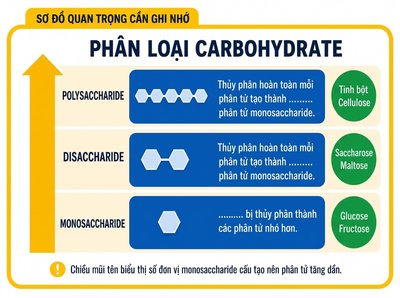
Monosaccharide, disaccharide, polysaccharide
Hydrolysis: Breaking down larger carbohydrates into smaller units
General formula:
Step-by-Step Guidance
Recall the three main classes of carbohydrates based on hydrolysis: mono-, di-, and polysaccharides.
Check if the general formula applies to all carbohydrates.
Determine if monosaccharides always contain only one unit in their formula.
Review the hydrolysis of sucrose and what products are formed.
Evaluate each statement (a–d) for correctness.
Try solving on your own before revealing the answer!
Final Answer:
a: Đúng
b: Đúng
c: Sai (monosaccharides can have various and values)
d: Đúng
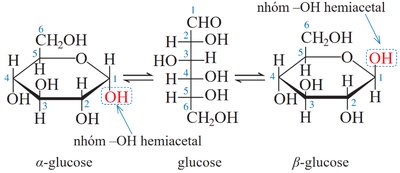
Q6. Analyze statements about the open-chain and cyclic forms of glucose.
Background
Topic: Glucose Structure – Open-chain and Cyclic Forms
This question tests your understanding of the different forms of glucose and their interconversion in solution.
Key Terms and Formulas
Open-chain (acyclic) form: Contains an aldehyde group and multiple hydroxy groups.
Cyclic (ring) forms: α- and β-glucose, both are six-membered rings (pyranose).
Hemiacetal: Formed when an aldehyde reacts with an alcohol group within the same molecule.
Step-by-Step Guidance
Recall the molecular formula of glucose and its open-chain structure.
Identify the number of hydroxy and aldehyde groups in the open-chain form.
Understand the formation of α- and β-glucose (both are six-membered rings).
Know that open-chain and cyclic forms interconvert in solution, but one form predominates.
Evaluate each statement (a–g) for correctness.
Try solving on your own before revealing the answer!
Final Answer:
a: Đúng
b: Đúng
c: Đúng
d: Sai (the cyclic forms predominate in solution)
e: Sai (open-chain form ends with -CHO, not -OH)
g: Đúng
Q7. Identify the product X in the reaction of glucose with Tollens' reagent.
Background
Topic: Redox Reactions of Aldehydes (Glucose) with Tollens' Reagent
This question tests your understanding of the oxidation of glucose and the identification of the product formed.
Key Terms and Formulas
Tollens' reagent: , oxidizes aldehydes to carboxylic acids.
Glucose: Contains an aldehyde group in its open-chain form.
Product: Aldehyde is oxidized to carboxylate (gluconic acid or its salt).
Step-by-Step Guidance
Write the reaction: glucose + Tollens' reagent → silver + carboxylate product.
Identify which group in glucose is oxidized (the aldehyde group).
Determine the structure of the oxidized product (carboxylic acid or its salt).
Match the product to the given answer choices.
Try solving on your own before revealing the answer!
Final Answer: A.
The aldehyde group is oxidized to a carboxylic acid group, forming gluconic acid.
Q8. Analyze observations from experiments testing glucose's chemical properties.
Background
Topic: Chemical Properties of Glucose – Laboratory Tests
This question tests your understanding of the reactions of glucose with Benedict's, Tollens', and bromine water, and the interpretation of observed phenomena.
Key Terms and Formulas
Benedict's/Fehling's test: Blue solution, tests for reducing sugars.
Tollens' test: Silver mirror test for aldehydes.
Bromine water: Tests for aldehyde group (decolorization).
Step-by-Step Guidance
Recall the expected color changes and products for each test with glucose.
Determine what happens if fructose is used instead of glucose.
Evaluate each statement (a–d) for correctness based on the reactions and observations.
Try solving on your own before revealing the answer!
Final Answer:
a: Đúng
b: Đúng
c: Sai (bromine water tests for aldehyde, not polyalcohol)
d: Sai (fructose may not give identical results in all tests)
Q9. Analyze statements about the chemical properties of glucose.
Background
Topic: Chemical Properties of Glucose – Polyalcohol and Aldehyde Reactions
This question tests your understanding of the reactions of glucose with alcohols, fermentation, and reactions with copper(II) hydroxide.
Key Terms and Formulas
Hemiacetal: Formed at C1 in glucose, reacts with methanol.
Fermentation: Glucose can be converted to ethanol or acids depending on enzymes.
Polyalcohol: Multiple -OH groups, reacts with .
Step-by-Step Guidance
Recall the reaction of glucose with methanol in acidic conditions (forms methyl glucoside).
Identify which group in glucose reacts with methanol (hemiacetal -OH at C1).
Understand the fermentation products of glucose.
Review the reaction of glucose with as a test for polyalcohols.
Evaluate each statement (a–d) for correctness.
Try solving on your own before revealing the answer!
Final Answer:
a: Sai (forms methyl α-glucoside, not β)
b: Đúng
c: Đúng
d: Đúng
Q10. Analyze statements about the chemical properties of glucose (continued).
Background
Topic: Glucose – Reactions with Alcohols, Fermentation, and Aldehyde Properties
This question tests your understanding of the specific reactions of glucose, including the formation of glucosides and fermentation processes.
Key Terms and Formulas
Glucoside formation: Reaction at C1 -OH (hemiacetal group).
Fermentation: Lactic acid vs. acetic acid production.
Aldehyde reactions: With , bromine water, Tollens' reagent.
Step-by-Step Guidance
Recall which carbon in glucose reacts with methanol in the presence of HCl (C1).
Determine if both α- and β-glucose can react to form both methyl α- and β-glucosides.
Understand the difference between lactic and acetic acid fermentation.
Review which reactions demonstrate the aldehyde property of glucose.
Evaluate each statement (a–d) for correctness.
Try solving on your own before revealing the answer!
Final Answer:
a: Đúng
b: Sai (both α- and β-glucose can react)
c: Sai (lactic acid fermentation does not produce acetic acid)
d: Đúng
Q11. What is the main role of glucose in the human body?
Background
Topic: Biological Role of Glucose
This question tests your understanding of the physiological importance of glucose in metabolism.
Key Terms and Formulas
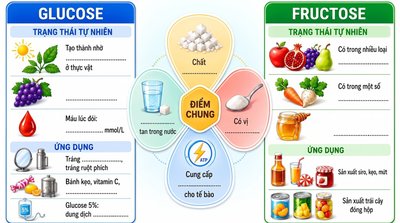
Glucose: Main energy source for cellular processes.
ATP: Energy currency of the cell, produced from glucose metabolism.
Step-by-Step Guidance
Recall the main metabolic function of glucose in the body.
Eliminate options that do not relate to energy supply.
Identify the correct answer based on glucose's role in cellular respiration.
Try solving on your own before revealing the answer!
Final Answer: C. Cung cấp năng lượng cho quá trình sinh hoá tế bào.
Glucose is the primary energy source for cells.
Q12. Analyze statements about the properties and occurrence of fructose.
Background
Topic: Fructose – Physical Properties and Biological Occurrence
This question tests your knowledge of fructose's physical properties, sources, and comparison with glucose.
Key Terms and Formulas
Fructose: Monosaccharide, very soluble, sweeter than glucose.
Sources: Honey, fruits.
Step-by-Step Guidance
Recall the physical state and solubility of fructose at room temperature.
Identify common natural sources of fructose.
Compare the sweetness of fructose and glucose.
Determine if fructose is always present in human blood.
Evaluate each statement (a–d) for correctness.
Try solving on your own before revealing the answer!
Final Answer:
a: Đúng
b: Đúng
c: Đúng
d: Sai (fructose is not always present in blood at a fixed concentration)
Q13. Given blood glucose data, select the correct statements about blood sugar levels and their regulation.
Background
Topic: Blood Glucose Regulation and Clinical Interpretation
This question tests your ability to interpret blood glucose values and understand physiological responses to hypoglycemia and hyperglycemia.
Key Terms and Formulas
Normal fasting blood glucose: 4.4–7.2 mmol/L (or 80–130 mg/dL).
Hypoglycemia: Low blood sugar, requires glucose supplementation.
Hyperglycemia: High blood sugar, managed by insulin.
Step-by-Step Guidance
Convert the given blood glucose value to the same units as the reference range if needed.
Compare the student's value to the normal range to determine if it is low or high.
Recall the physiological response to eating carbohydrates when fasting.
Identify the correct actions for hypoglycemia.
List the correct statements in increasing order.
Try solving on your own before revealing the answer!
Final Answer: 1, 3, 4
Statement 2 is incorrect because 152 mg/dL is above the normal range.
Q14. Analyze statements about the properties and sweetness of fructose.
Background
Topic: Fructose – Physical Properties, Sources, and Sweetness
This question tests your understanding of the physical properties, sources, and sweetness of fructose compared to glucose.
Key Terms and Formulas
Fructose: Monosaccharide, very sweet, found in honey and fruits.
Sweetness: Fructose is sweeter than glucose.
Step-by-Step Guidance
Recall the physical state and solubility of fructose.
Identify the main sources of fructose in nature.
Compare the sweetness of fructose and glucose.
Determine if fructose is always present in blood.
Evaluate each statement (a–g) for correctness.
Try solving on your own before revealing the answer!
Final Answer:
a: Đúng
b: Đúng
c: Đúng
d: Sai
e: Sai (fructose is sweeter than glucose)
g: Đúng
Q15. Calculate the energy provided by a glass of sugar water made from 100 mL water and 50 g sugar (397 kcal/100 g).
Background
Topic: Calorimetry – Energy Content of Foods
This question tests your ability to calculate the energy content of a given mass of sugar using nutritional data.
Key Terms and Formulas
Energy content: Given in kcal per 100 g sugar.
Proportional calculation:
Step-by-Step Guidance
Identify the mass of sugar used (50 g).
Set up the proportion to calculate the energy provided by 50 g of sugar.
Multiply the energy per 100 g by the ratio .
Perform the calculation to find the energy value (do not round or state the final value yet).
Try solving on your own before revealing the answer!
Final Answer: 199 kcal
kcal
Q16. Calculate the maximum energy (in kJ) obtained from glucose in 2 days, given 1 bottle/day of 250 mL 5% glucose solution.
Background
Topic: Calorimetry – Energy from Glucose Oxidation
This question tests your ability to calculate the energy released from the oxidation of glucose, using solution concentration and reaction enthalpy.
Key Terms and Formulas
5% glucose solution: 5 g glucose per 100 mL solution.
Enthalpy of reaction: kJ per mole glucose oxidized.
Molar mass of glucose: g/mol.
Step-by-Step Guidance
Calculate the total volume of solution administered in 2 days (2 × 250 mL).
Determine the total mass of glucose given (using 5% w/v concentration).
Convert the mass of glucose to moles using its molar mass.
Multiply the number of moles by the enthalpy change per mole to find the total energy released.
Round the final answer to the nearest integer (do not state the value yet).
Try solving on your own before revealing the answer!
Final Answer: 139 kJ
Total glucose: 25 g; Moles: mol; Energy: kJ (absolute value, rounded).
