Ch.10 Proteins Workers of the Cell
Frost - General, Organic and Biological Chemistry 4th Edition
Frost4th EditionGeneral, Organic and Biological ChemistryISBN: 9780134988696당신이 사용하는 게 아니라요?교과서 변경
6장, 문제 28b

Determine whether each of the following statements describes the primary, secondary, tertiary, or quaternary structure of a protein.
b. Peptide bonds join amino acids in a polypeptide chain.

검증된 단계별 안내
1
Understand the four levels of protein structure: Primary structure refers to the sequence of amino acids in a polypeptide chain, held together by peptide bonds. Secondary structure involves local folding patterns like alpha-helices and beta-sheets, stabilized by hydrogen bonds. Tertiary structure describes the overall 3D shape of a single polypeptide chain, stabilized by various interactions (e.g., hydrogen bonds, ionic bonds, hydrophobic interactions, and disulfide bridges). Quaternary structure refers to the arrangement of multiple polypeptide chains into a functional protein complex.
Focus on the statement: 'Peptide bonds join amino acids in a polypeptide chain.' This describes the specific type of bond that links amino acids together in a linear sequence.
Recall that peptide bonds are covalent bonds formed during a condensation reaction between the carboxyl group of one amino acid and the amino group of another amino acid, resulting in the release of a water molecule.
Recognize that the sequence of amino acids linked by peptide bonds defines the primary structure of a protein. This level of structure is solely determined by the order of amino acids in the chain.
Conclude that the statement describes the primary structure of a protein, as it specifically refers to the peptide bonds that form the backbone of the polypeptide chain.

비슷한 문제에 대한 검증된 영상 답변:

이 영상 해법은 위 문제에 도움이 된다고 튜터들이 추천한 것입니다.
영상 길이:
2m
도움이 되었나요?

주요 개념

질문에 올바르게 답하기 위해 반드시 이해해야 하는 핵심 개념들은 다음과 같습니다.

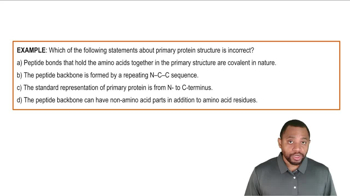
Primary Structure

The primary structure of a protein refers to its unique sequence of amino acids linked together by peptide bonds. This linear arrangement determines the protein's identity and is crucial for its subsequent folding and function. Any change in this sequence can lead to significant alterations in the protein's properties.
추천 영상:
가이드 코스
1:11
Primary Protein Structure Example 1

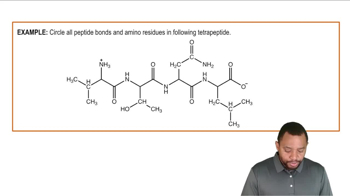
Peptide Bonds

Peptide bonds are covalent chemical bonds that form between the carboxyl group of one amino acid and the amino group of another, releasing a molecule of water in the process. These bonds are fundamental in creating polypeptide chains, which are the building blocks of proteins, and they dictate the primary structure of the protein.
추천 영상:
가이드 코스
1:24
Peptides Example 1

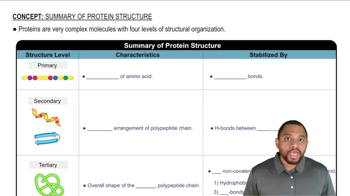
Protein Structure Levels

Proteins have four levels of structure: primary, secondary, tertiary, and quaternary. Each level represents a different aspect of protein organization, from the linear sequence of amino acids (primary) to the overall three-dimensional shape (tertiary) and the assembly of multiple polypeptide chains (quaternary). Understanding these levels is essential for grasping how proteins function.
추천 영상:
가이드 코스
2:56
Summary of Protein Structure Concept 1