Ch.10 Proteins Workers of the Cell
Frost - General, Organic and Biological Chemistry 4th Edition
Frost4th EditionGeneral, Organic and Biological ChemistryISBN: 9780134988696당신이 사용하는 게 아니라요?교과서 변경
6장, 문제 12b

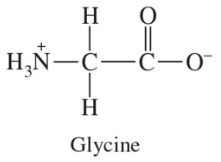
Glycine has the zwitterion structure shown. Draw the structure and give the net charge of glycine that will predominate at the indicated pH values (pI = 6.0).
b. pH 12.0

검증된 단계별 안내
1
Understand the concept of a zwitterion: A zwitterion is a molecule that has both positive and negative charges but is overall electrically neutral. Glycine, an amino acid, exists as a zwitterion at its isoelectric point (pI), which is pH 6.0 in this case.
At pH values above the pI (e.g., pH 12.0), the environment is basic, meaning there is a low concentration of H⁺ ions. This will affect the protonation state of glycine's functional groups.
Identify the functional groups in glycine: Glycine has an amino group (-NH₃⁺ in its protonated form) and a carboxylic acid group (-COO⁻ in its deprotonated form). At pH 12.0, the amino group will lose a proton, becoming -NH₂, while the carboxylic acid group remains deprotonated as -COO⁻.
Determine the net charge: At pH 12.0, the amino group (-NH₂) is neutral, and the carboxylate group (-COO⁻) carries a negative charge. Therefore, the net charge of glycine at pH 12.0 is -1.
Draw the structure: The structure of glycine at pH 12.0 will have the central carbon atom bonded to a hydrogen atom, a -CH₂ group, a neutral -NH₂ group, and a negatively charged -COO⁻ group. This reflects the deprotonated state of glycine in a basic environment.

비슷한 문제에 대한 검증된 영상 답변:

이 영상 해법은 위 문제에 도움이 된다고 튜터들이 추천한 것입니다.
영상 길이:
2m
도움이 되었나요?

주요 개념

질문에 올바르게 답하기 위해 반드시 이해해야 하는 핵심 개념들은 다음과 같습니다.

Zwitterion Structure

A zwitterion is a molecule that has both positive and negative charges but is overall neutral. In the case of amino acids like glycine, the amino group (-NH3+) carries a positive charge, while the carboxyl group (-COO-) carries a negative charge. This dual charge allows zwitterions to exist in a stable form in solution, particularly at physiological pH levels.
추천 영상:
가이드 코스
1:01
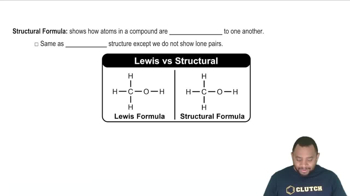
Structural Formula Concept 2

Isoelectric Point (pI)

The isoelectric point (pI) is the pH at which a molecule, such as an amino acid, carries no net electrical charge. For glycine, the pI is 6.0, meaning that at this pH, the positive and negative charges balance out. Understanding the pI is crucial for predicting the charge of glycine at different pH levels, which influences its solubility and interactions in biological systems.
추천 영상:
가이드 코스
03:05
Boiling Point Elevation Concept 1

pH and Charge Relationship

The pH of a solution affects the ionization state of amino acids. At pH values below the pI, glycine will predominantly exist in its positively charged form, while at pH values above the pI, it will exist in its negatively charged form. At pH 12.0, which is significantly above the pI, glycine will predominantly be negatively charged due to the deprotonation of the amino group.
추천 영상:
가이드 코스
04:56
Logarithmic Relationships