Ch.10 Proteins Workers of the Cell
Frost - General, Organic and Biological Chemistry 4th Edition
Frost4th EditionGeneral, Organic and Biological ChemistryISBN: 9780134988696당신이 사용하는 게 아니라요?교과서 변경
6장, 문제 22

How many different tripeptides that contain one leucine, one glutamate, and one tryptophan are possible?

검증된 단계별 안내
1
Identify the amino acids involved: leucine (L), glutamate (E), and tryptophan (W).
Recognize that a tripeptide is a sequence of three amino acids.
Determine the number of possible sequences by considering the permutations of the three amino acids.
Use the formula for permutations of n distinct items: n! (n factorial), where n is the number of items.
Calculate 3! to find the number of different tripeptides possible.

비슷한 문제에 대한 검증된 영상 답변:

이 영상 해법은 위 문제에 도움이 된다고 튜터들이 추천한 것입니다.
영상 길이:
51s
도움이 되었나요?

주요 개념

질문에 올바르게 답하기 위해 반드시 이해해야 하는 핵심 개념들은 다음과 같습니다.

Amino Acids

Amino acids are organic compounds that serve as the building blocks of proteins. Each amino acid has a specific structure, consisting of a central carbon atom, an amino group, a carboxyl group, a hydrogen atom, and a variable side chain (R group) that determines its properties. In this question, leucine, glutamate, and tryptophan are specific amino acids that will be combined to form tripeptides.
추천 영상:
가이드 코스
3:03
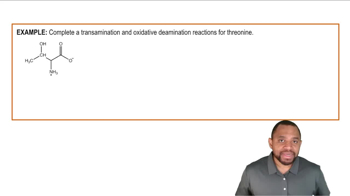
Amino Acid Catabolism: Amino Group Example 2

Tripeptides

Tripeptides are molecules formed by the linkage of three amino acids through peptide bonds. The sequence and arrangement of these amino acids are crucial, as they determine the tripeptide's properties and functions. In this case, the tripeptides will consist of one leucine, one glutamate, and one tryptophan, and the order in which they are arranged will affect the total number of unique tripeptides possible.
추천 영상:
가이드 코스
3:07
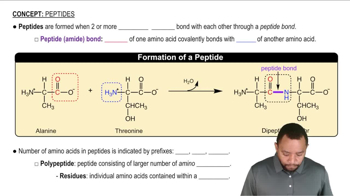
Peptides Concept 1

Permutations

Permutations refer to the different ways in which a set of items can be arranged or ordered. In the context of the question, the three distinct amino acids can be arranged in various sequences, and the number of unique arrangements can be calculated using the factorial of the number of items. For three amino acids, the number of permutations is 3! (3 factorial), which equals 6, indicating the total different tripeptides that can be formed.