Ch.10 Proteins Workers of the Cell
Frost - General, Organic and Biological Chemistry 4th Edition
Frost4th EditionGeneral, Organic and Biological ChemistryISBN: 9780134988696당신이 사용하는 게 아니라요?교과서 변경
6장, 문제 110b

Insulin is a protein hormone that functions as two polypeptide chains whose amino acid sequences are as follows:
A chain: GIVEQCCTSICSLTQLENYCN
B chain: FVNQHLCGDHLVEALYLV CGERGFFYTPKT
b. Considering the amino acid sequences, suggest how these two polypeptide chains might be held together in an active insulin molecule.

검증된 단계별 안내
1
Identify the types of interactions that can occur between amino acids in polypeptide chains. These include hydrogen bonds, ionic bonds, hydrophobic interactions, and disulfide bridges.
Examine the amino acid sequences of the A and B chains for cysteine (C) residues, as these can form disulfide bridges, which are covalent bonds that can link different parts of a protein or different polypeptide chains.
Note that the A chain contains cysteine residues at positions 6 and 20, and the B chain contains cysteine residues at positions 7 and 19.
Propose that disulfide bridges could form between cysteine residues in the A and B chains, specifically between A6 and B7, and A20 and B19, helping to stabilize the active insulin structure.
Consider other interactions such as hydrogen bonds and hydrophobic interactions that might also contribute to the overall stability and conformation of the insulin molecule.

비슷한 문제에 대한 검증된 영상 답변:

이 영상 해법은 위 문제에 도움이 된다고 튜터들이 추천한 것입니다.
영상 길이:
4m
도움이 되었나요?

주요 개념

질문에 올바르게 답하기 위해 반드시 이해해야 하는 핵심 개념들은 다음과 같습니다.

Protein Structure

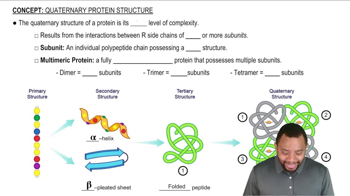
Proteins are composed of amino acids linked by peptide bonds, forming polypeptide chains. The structure of a protein is crucial for its function, and it typically exists in four levels: primary (amino acid sequence), secondary (local folding patterns), tertiary (overall 3D shape), and quaternary (assembly of multiple polypeptide chains). In the case of insulin, understanding how the A and B chains interact is essential for grasping its functionality.
추천 영상:
가이드 코스
3:26
Quaternary Protein Structure Concept 1

Disulfide Bonds

Disulfide bonds are covalent linkages formed between the sulfur atoms of cysteine residues in proteins. These bonds play a critical role in stabilizing the three-dimensional structure of proteins, particularly in secreted proteins like insulin. In insulin, disulfide bonds between the A and B chains help maintain its active conformation, ensuring proper biological activity.
추천 영상:

Protein Folding and Function

The process of protein folding is vital for the biological activity of proteins, as the specific shape of a protein determines its function. In insulin, the correct folding of the A and B chains, facilitated by interactions such as hydrogen bonds, hydrophobic interactions, and disulfide bonds, is necessary for its role in glucose regulation. Understanding how these chains come together provides insight into insulin's mechanism of action.
추천 영상:
가이드 코스
02:16
Logarithmic Functions