Ch.11 Nucleic Acids Big Molecules with a Big Role
Frost - General, Organic and Biological Chemistry 4th Edition
Frost4th EditionGeneral, Organic and Biological ChemistryISBN: 9780134988696당신이 사용하는 게 아니라요?교과서 변경
7장, 문제 55e

Identify each of the following bases as a pyrimidine or a purine:
e. guanine

검증된 단계별 안내
1
Understand the difference between purines and pyrimidines: Purines are larger, double-ring structures, while pyrimidines are smaller, single-ring structures. This distinction is key to identifying the type of base.
Recall the specific bases that belong to each category: Purines include adenine and guanine, while pyrimidines include cytosine, thymine, and uracil.
Examine the base in question, guanine. Guanine is one of the nitrogenous bases found in DNA and RNA.
Recognize that guanine has a double-ring structure, which is characteristic of purines.
Conclude that guanine is classified as a purine based on its structural features and categorization.

비슷한 문제에 대한 검증된 영상 답변:

이 영상 해법은 위 문제에 도움이 된다고 튜터들이 추천한 것입니다.
영상 길이:
3m

주요 개념

질문에 올바르게 답하기 위해 반드시 이해해야 하는 핵심 개념들은 다음과 같습니다.

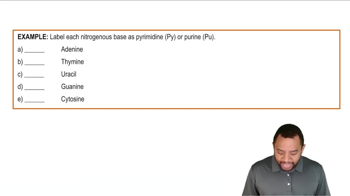
Pyrimidines and Purines

Pyrimidines and purines are the two categories of nitrogenous bases found in nucleic acids. Pyrimidines, which include cytosine, thymine, and uracil, have a single six-membered ring structure. In contrast, purines, such as adenine and guanine, consist of a fused double-ring structure, which includes a six-membered and a five-membered ring. Understanding these classifications is essential for identifying the structure and function of nucleotides in DNA and RNA.
추천 영상:
가이드 코스
1:09
Nitrogenous Bases Example 1

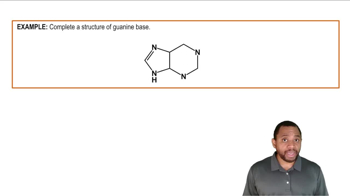
Guanine

Guanine is one of the five primary nitrogenous bases in nucleic acids and is classified as a purine. It plays a crucial role in the structure of DNA and RNA, pairing with cytosine in DNA and RNA molecules. Guanine is essential for various biological processes, including protein synthesis and energy transfer, as it is a component of important molecules like GTP (guanosine triphosphate).
추천 영상:
가이드 코스
1:23
Nitrogenous Bases Example 3

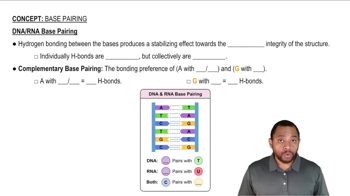
Base Pairing

Base pairing refers to the specific hydrogen bonding between nitrogenous bases in DNA and RNA, which is fundamental for the stability and replication of genetic material. In DNA, adenine pairs with thymine, while guanine pairs with cytosine. This complementary pairing ensures accurate transmission of genetic information during cell division and is critical for the processes of transcription and translation in protein synthesis.
추천 영상:
가이드 코스
2:56
Base Pairing Concept 1