Ch.11 Nucleic Acids Big Molecules with a Big Role
Frost - General, Organic and Biological Chemistry 4th Edition
Frost4th EditionGeneral, Organic and Biological ChemistryISBN: 9780134988696당신이 사용하는 게 아니라요?교과서 변경
7장, 문제 10a

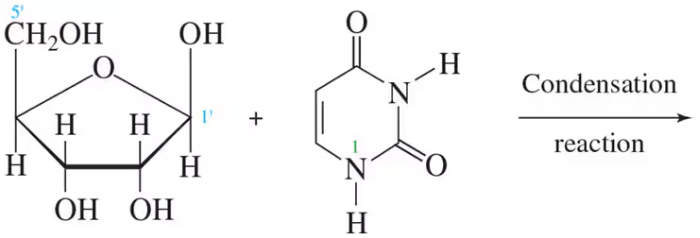
Provide the products for each of the following condensation reactions:
a. Chemical structures of a sugar and a nitrogenous base illustrating a condensation reaction with an arrow indicating the process.

검증된 단계별 안내
1
Step 1: Understand the concept of a condensation reaction. A condensation reaction typically involves the combination of two molecules with the elimination of a small molecule, such as water (H₂O) or methanol (CH₃OH). This reaction often occurs between functional groups like alcohols, carboxylic acids, or amines.
Step 2: Analyze the reactants provided in the image (not shown here). Identify the functional groups present in the molecules that will participate in the condensation reaction. Common functional groups include hydroxyl (-OH), carboxyl (-COOH), and amino (-NH₂).
Step 3: Determine the type of bond formed during the reaction. For example, if the reaction involves a carboxylic acid and an alcohol, an ester bond will form, and water will be eliminated. If the reaction involves a carboxylic acid and an amine, an amide bond will form, and water will be eliminated.
Step 4: Write the chemical equation for the reaction. Represent the reactants and products using their chemical formulas. For example, if the reactants are R-COOH (carboxylic acid) and R'-OH (alcohol), the product will be R-COOR' (ester) + H₂O.
Step 5: Verify the products formed. Ensure that the small molecule (e.g., H₂O) is correctly eliminated and the new bond (e.g., ester or amide) is properly formed. Double-check the stoichiometry and structural arrangement of the products.

비슷한 문제에 대한 검증된 영상 답변:

이 영상 해법은 위 문제에 도움이 된다고 튜터들이 추천한 것입니다.
영상 길이:
1m

주요 개념

질문에 올바르게 답하기 위해 반드시 이해해야 하는 핵심 개념들은 다음과 같습니다.

Condensation Reaction

A condensation reaction is a chemical process where two molecules combine to form a larger molecule, accompanied by the loss of a small molecule, often water. This type of reaction is fundamental in organic chemistry, particularly in the formation of polymers and larger organic compounds. Understanding the mechanism of condensation reactions is crucial for predicting the products formed in such reactions.
추천 영상:
가이드 코스
1:53
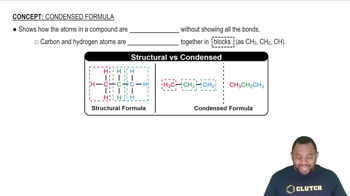
Condensed Formula Concept 1

Functional Groups

Functional groups are specific groups of atoms within molecules that are responsible for the characteristic chemical reactions of those molecules. In condensation reactions, the presence of certain functional groups, such as alcohols, carboxylic acids, or amines, influences the type of products formed. Identifying these groups helps in predicting the outcome of the reaction.
추천 영상:
가이드 코스
1:11
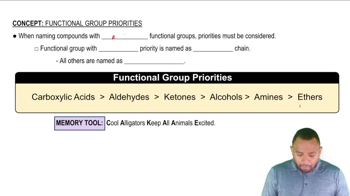
Functional Group Priorities Concept 1

Reaction Mechanism

A reaction mechanism is a step-by-step description of the process by which reactants are converted into products in a chemical reaction. It outlines the sequence of bond-breaking and bond-forming events that occur. Understanding the mechanism of condensation reactions allows chemists to anticipate the products and the conditions required for the reaction to proceed efficiently.
추천 영상:
가이드 코스
1:30
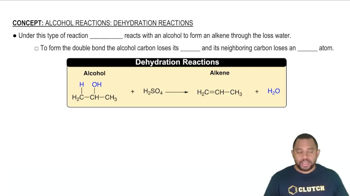
Alcohol Reactions: Dehydration Reactions Concept 1