Ch.11 Nucleic Acids Big Molecules with a Big Role
Frost - General, Organic and Biological Chemistry 4th Edition
Frost4th EditionGeneral, Organic and Biological ChemistryISBN: 9780134988696당신이 사용하는 게 아니라요?교과서 변경
7장, 문제 20d

Write the base sequence and label the 3' and 5' ends of the complementary strand for a segment of DNA with the following base sequences:
d. 5'CGCGATATTA3'

검증된 단계별 안내
1
Step 1: Understand the structure of DNA. DNA is composed of two strands that are complementary and antiparallel. This means that the bases pair according to specific rules (A pairs with T, and C pairs with G) and the strands run in opposite directions (5' to 3' and 3' to 5').
Step 2: Identify the given strand's sequence and direction. The problem provides the sequence 5'CGCGATATTA3', which runs from the 5' end to the 3' end.
Step 3: Apply the base-pairing rules to determine the complementary strand. For each base in the given strand: C pairs with G, G pairs with C, A pairs with T, and T pairs with A.
Step 4: Reverse the direction of the complementary strand. Since DNA strands are antiparallel, the complementary strand will run from 3' to 5'. Write the complementary bases in reverse order to reflect this direction.
Step 5: Label the ends of the complementary strand. After determining the sequence and reversing the direction, label the 3' and 5' ends appropriately to complete the complementary strand.

비슷한 문제에 대한 검증된 영상 답변:

이 영상 해법은 위 문제에 도움이 된다고 튜터들이 추천한 것입니다.
영상 길이:
3m
도움이 되었나요?

주요 개념

질문에 올바르게 답하기 위해 반드시 이해해야 하는 핵심 개념들은 다음과 같습니다.

DNA Structure

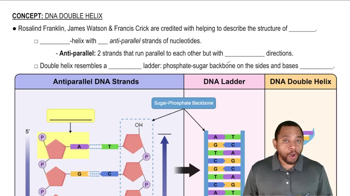
DNA is composed of two strands that form a double helix, with each strand made up of nucleotides. Each nucleotide consists of a phosphate group, a sugar (deoxyribose), and a nitrogenous base (adenine, thymine, cytosine, or guanine). The strands are oriented in opposite directions, with one running 5' to 3' and the other 3' to 5', which is crucial for understanding base pairing and replication.
추천 영상:
가이드 코스
3:27
DNA Double Helix Concept 1

Complementary Base Pairing

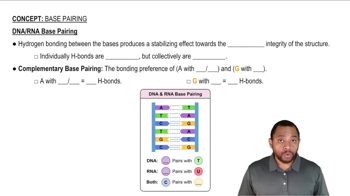
In DNA, complementary base pairing occurs between specific nitrogenous bases: adenine pairs with thymine (A-T) and cytosine pairs with guanine (C-G). This pairing is essential for the accurate replication of DNA and the formation of the complementary strand. Understanding this concept is vital for determining the sequence of the complementary strand based on the given sequence.
추천 영상:
가이드 코스
2:56
Base Pairing Concept 1

5' and 3' Ends

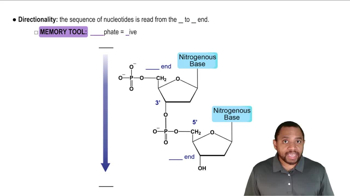
The terms 5' (five prime) and 3' (three prime) refer to the directionality of the DNA strands. The 5' end has a phosphate group attached to the fifth carbon of the sugar, while the 3' end has a hydroxyl group attached to the third carbon. Labeling these ends is important for understanding the orientation of the DNA strands and how they interact during processes like transcription and replication.
추천 영상:
가이드 코스
1:43
Primary Structure of Nucleic Acids Concept 2