Ch.12 Food as Fuel An Overview of Metabolism
Frost - General, Organic and Biological Chemistry 4th Edition
Frost4th EditionGeneral, Organic and Biological ChemistryISBN: 9780134988696당신이 사용하는 게 아니라요?교과서 변경
8장, 문제 66b

Identify each pathway as anabolic or catabolic
b. citric acid cycle

검증된 단계별 안내
1
Understand the definitions of anabolic and catabolic pathways: Anabolic pathways involve the synthesis of complex molecules from simpler ones, requiring energy input. Catabolic pathways involve the breakdown of complex molecules into simpler ones, releasing energy.
Recall the purpose of the citric acid cycle (also known as the Krebs cycle or TCA cycle): It is a central metabolic pathway that breaks down acetyl-CoA into carbon dioxide while generating high-energy molecules like NADH and FADH2.
Analyze the process: The citric acid cycle involves the degradation of acetyl-CoA, which is a complex molecule, into simpler molecules (CO2) and the production of energy-rich compounds.
Determine the classification: Since the citric acid cycle is primarily involved in breaking down molecules and releasing energy, it is classified as a catabolic pathway.
Conclude that the citric acid cycle is a catabolic pathway based on its role in energy production and molecular breakdown.

비슷한 문제에 대한 검증된 영상 답변:

이 영상 해법은 위 문제에 도움이 된다고 튜터들이 추천한 것입니다.
영상 길이:
1m

주요 개념

질문에 올바르게 답하기 위해 반드시 이해해야 하는 핵심 개념들은 다음과 같습니다.

Anabolic Pathways

Anabolic pathways are metabolic processes that build larger molecules from smaller ones, requiring energy input. These pathways are essential for growth, repair, and the synthesis of complex biomolecules like proteins, nucleic acids, and lipids. An example of an anabolic process is protein synthesis, where amino acids are linked together to form proteins.
추천 영상:
가이드 코스
2:13
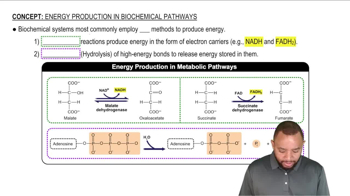
Energy Production In Biochemical Pathways Concept 1

Catabolic Pathways

Catabolic pathways are metabolic processes that break down larger molecules into smaller ones, releasing energy in the process. This energy is often captured in the form of ATP, which cells use for various functions. An example of a catabolic process is cellular respiration, where glucose is broken down to produce energy.
추천 영상:
가이드 코스
2:13
Energy Production In Biochemical Pathways Concept 1

Citric Acid Cycle

The citric acid cycle, also known as the Krebs cycle, is a key metabolic pathway that plays a central role in cellular respiration. It is primarily catabolic, as it breaks down acetyl-CoA derived from carbohydrates, fats, and proteins into carbon dioxide and high-energy electron carriers. These carriers then enter the electron transport chain to produce ATP, highlighting the cycle's importance in energy production.
추천 영상:
가이드 코스
2:31
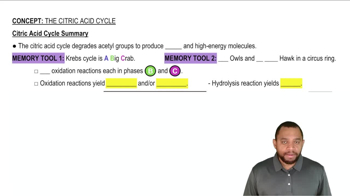
Citric Acid Cycle Summary Concept 12