Ch.4 Introduction to Organic Compounds
Frost - General, Organic and Biological Chemistry 4th Edition
Frost4th EditionGeneral, Organic and Biological ChemistryISBN: 9780134988696당신이 사용하는 게 아니라요?교과서 변경
1장, 문제 39a

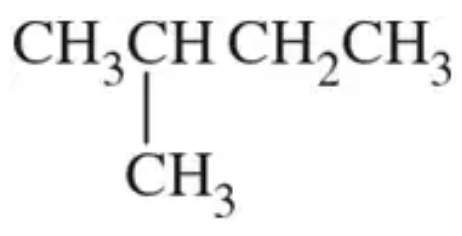
Convert the condensed structures shown to skeletal structures.
(a) Condensed chemical structure showing a branched alkane with carbon and hydrogen atoms.

검증된 단계별 안내
1
Identify the condensed structure provided in the problem. Condensed structures represent molecules in a compact form, showing the connectivity of atoms without explicitly drawing bonds.
Understand the skeletal structure format. In skeletal structures, carbon atoms are represented as vertices or endpoints of lines, and hydrogen atoms bonded to carbons are implied rather than explicitly shown.
Analyze the condensed structure to determine the arrangement of carbon atoms and any functional groups or substituents. Pay attention to branching and double or triple bonds if present.
Draw the skeletal structure by placing carbon atoms as vertices and connecting them with lines to represent bonds. Add any functional groups explicitly, such as -OH, -Cl, or =O, while omitting hydrogens bonded to carbons.
Double-check the skeletal structure to ensure it accurately represents the connectivity and bonding of the original condensed structure, including the correct number of bonds for each carbon atom.

비슷한 문제에 대한 검증된 영상 답변:

이 영상 해법은 위 문제에 도움이 된다고 튜터들이 추천한 것입니다.
영상 길이:
2m
도움이 되었나요?

주요 개념

질문에 올바르게 답하기 위해 반드시 이해해야 하는 핵심 개념들은 다음과 같습니다.

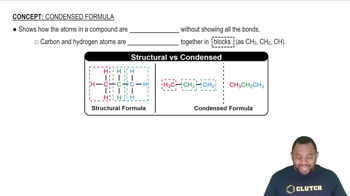
Condensed Structures

Condensed structures are a simplified way of representing molecular structures that show the connectivity of atoms without depicting all the bonds explicitly. They often use shorthand notation to indicate functional groups and the arrangement of atoms, making it easier to visualize complex molecules. Understanding condensed structures is essential for converting them into skeletal structures.
추천 영상:
가이드 코스
1:53
Condensed Formula Concept 1

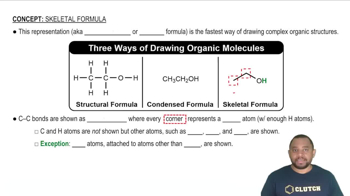
Skeletal Structures

Skeletal structures, also known as line-angle formulas, represent organic molecules by showing only the bonds between carbon atoms as lines, with vertices representing carbon atoms. Hydrogen atoms attached to carbons are usually omitted for simplicity. This representation is crucial for visualizing the overall shape and connectivity of the molecule, which aids in understanding its chemical properties and reactivity.
추천 영상:
가이드 코스
2:26
Skeletal Formula Concept 1

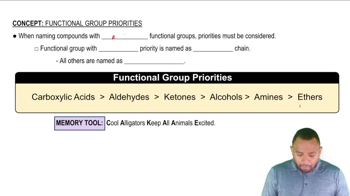
Functional Groups

Functional groups are specific groups of atoms within molecules that are responsible for the characteristic chemical reactions of those molecules. They play a key role in determining the properties and behavior of organic compounds. Recognizing functional groups in condensed structures is vital for accurately converting them to skeletal structures, as they influence the overall structure and reactivity of the molecule.
추천 영상:
가이드 코스
1:11
Functional Group Priorities Concept 1