Ch.4 Introduction to Organic Compounds
Frost - General, Organic and Biological Chemistry 4th Edition
Frost4th EditionGeneral, Organic and Biological ChemistryISBN: 9780134988696당신이 사용하는 게 아니라요?교과서 변경
1장, 문제 5b

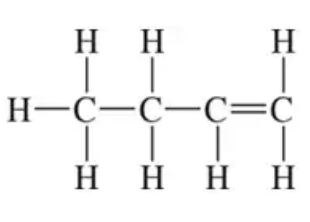
Draw a skeletal structure for each of the following compounds:
(b) Skeletal structure of a hydrocarbon chain with a double bond, showing carbon and hydrogen atoms.

검증된 단계별 안내
1
Step 1: Understand the concept of a skeletal structure. A skeletal structure (or line-angle formula) is a simplified organic chemistry representation where carbon atoms are represented by vertices (corners) or line ends, and hydrogen atoms bonded to carbons are implied but not shown explicitly. Non-carbon atoms (heteroatoms) and their attached hydrogens are explicitly shown.
Step 2: Analyze the given compound. Since the problem references an image, identify the functional groups, the number of carbon atoms, and any heteroatoms (e.g., oxygen, nitrogen, etc.) in the compound. This will help you determine the structure.
Step 3: Begin drawing the skeletal structure. Start by placing the carbon backbone as a series of connected lines. Each vertex or line end represents a carbon atom. Ensure the correct number of carbons is represented based on the compound's formula.
Step 4: Add any functional groups or heteroatoms to the structure. For example, if the compound contains an -OH group, place it on the appropriate carbon. Double or triple bonds should also be represented as double or triple lines between carbons.
Step 5: Verify the structure. Check that each carbon has four bonds (including implied hydrogens) and that the placement of functional groups and heteroatoms matches the compound's description. Adjust as necessary to ensure accuracy.

비슷한 문제에 대한 검증된 영상 답변:

이 영상 해법은 위 문제에 도움이 된다고 튜터들이 추천한 것입니다.
영상 길이:
1m

주요 개념

질문에 올바르게 답하기 위해 반드시 이해해야 하는 핵심 개념들은 다음과 같습니다.

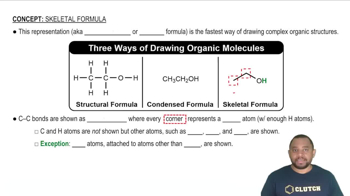
Skeletal Structures

Skeletal structures are simplified representations of organic molecules that depict the arrangement of atoms without showing all the hydrogen atoms explicitly. In these diagrams, carbon atoms are represented by vertices or ends of lines, while bonds between them are shown as lines. This method allows chemists to visualize complex molecules more easily and focus on functional groups and connectivity.
추천 영상:
가이드 코스
2:26
Skeletal Formula Concept 1

Functional Groups

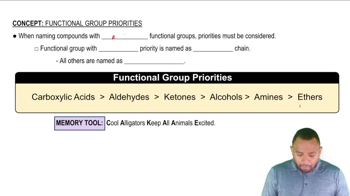
Functional groups are specific groups of atoms within molecules that are responsible for the characteristic chemical reactions of those molecules. They determine the properties and reactivity of organic compounds. Common functional groups include hydroxyl (-OH), carboxyl (-COOH), and amino (-NH2), and recognizing them is crucial for understanding the behavior of organic compounds in chemical reactions.
추천 영상:
가이드 코스
1:11
Functional Group Priorities Concept 1

Bonding and Hybridization

Bonding and hybridization refer to the ways in which atoms combine to form molecules. Hybridization is the concept of mixing atomic orbitals to create new hybrid orbitals that can form sigma and pi bonds. Understanding the types of bonds (single, double, triple) and the hybridization states (sp, sp2, sp3) of carbon is essential for accurately drawing skeletal structures and predicting molecular geometry.
추천 영상: