Ch.6 Carbohydrates Life's Sweet Molecules
Frost - General, Organic and Biological Chemistry 4th Edition
Frost4th EditionGeneral, Organic and Biological ChemistryISBN: 9780134988696당신이 사용하는 게 아니라요?교과서 변경
3장, 문제 54

Explain the difference between an aldose and a ketose.

검증된 단계별 안내
1
Identify the functional group present in the sugar molecule: Aldoses contain an aldehyde group (-CHO) at the end of the carbon chain, while ketoses contain a ketone group (C=O) typically at the second carbon atom.
Examine the structure of the sugar: Aldoses have the carbonyl group at the terminal carbon, making them an aldehyde, whereas ketoses have the carbonyl group at an internal carbon, making them a ketone.
Consider the simplest examples: Glucose is a common aldose, with the aldehyde group at the first carbon, while fructose is a common ketose, with the ketone group at the second carbon.
Understand the implications for reactivity: The position of the carbonyl group affects the sugar's reactivity and its ability to form cyclic structures, with aldoses typically forming hemiacetals and ketoses forming hemiketals.
Recognize the biological significance: Both aldoses and ketoses play crucial roles in metabolism and energy production, but their structural differences influence their specific functions and pathways in biological systems.

비슷한 문제에 대한 검증된 영상 답변:

이 영상 해법은 위 문제에 도움이 된다고 튜터들이 추천한 것입니다.
영상 길이:
2m
도움이 되었나요?

주요 개념

질문에 올바르게 답하기 위해 반드시 이해해야 하는 핵심 개념들은 다음과 같습니다.

Aldose

An aldose is a type of monosaccharide (simple sugar) that contains an aldehyde group (-CHO) at one end of its carbon chain. This functional group is responsible for the chemical properties of aldoses, making them reactive and capable of participating in various biochemical reactions. Common examples of aldoses include glucose and galactose.
추천 영상:
가이드 코스
0:39
Common Naming of Sugar Alcohols Concept 3

Ketose

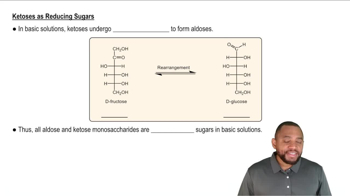
A ketose is another category of monosaccharide characterized by the presence of a ketone group (C=O) within the carbon chain, rather than at the end. This structural difference influences the reactivity and properties of ketoses. Fructose is a well-known example of a ketose, showcasing how the position of the carbonyl group affects the sugar's behavior.
추천 영상:
가이드 코스
1:03
Ketoses as Reducing Sugars Concept 2

Structural Isomerism

Structural isomerism refers to the phenomenon where compounds with the same molecular formula have different structural arrangements of atoms. In the case of aldoses and ketoses, both types of sugars share the same molecular formula (C_nH_(2n)O_n) but differ in the location of the carbonyl group, leading to distinct chemical properties and biological functions.
추천 영상:
가이드 코스
1:01
Structural Formula Concept 2