Ch.6 Carbohydrates Life's Sweet Molecules
Frost - General, Organic and Biological Chemistry 4th Edition
Frost4th EditionGeneral, Organic and Biological ChemistryISBN: 9780134988696당신이 사용하는 게 아니라요?교과서 변경
3장, 문제 75a

Will the following carbohydrates produce a positive Benedict's test?
a. D-glucose

검증된 단계별 안내
1
Understand the Benedict's test: The Benedict's test is used to identify reducing sugars. Reducing sugars are carbohydrates that have a free aldehyde group (-CHO) or a free ketone group that can be oxidized. When a reducing sugar is present, the Benedict's reagent (containing Cu2+) reacts with the sugar, producing a red-orange precipitate of Cu2O.
Identify the structure of d-glucose: d-glucose is a monosaccharide with an aldehyde functional group in its open-chain form. This aldehyde group makes d-glucose a reducing sugar.
Determine if d-glucose can undergo oxidation: Since d-glucose has a free aldehyde group, it can be oxidized by the Cu2+ ions in Benedict's reagent, resulting in a positive test.
Relate the result to the Benedict's test: Because d-glucose is a reducing sugar, it will produce a positive Benedict's test, forming a red-orange precipitate.
Conclude the reasoning: Based on the chemical properties of d-glucose and its ability to act as a reducing sugar, it will indeed produce a positive Benedict's test.

비슷한 문제에 대한 검증된 영상 답변:

이 영상 해법은 위 문제에 도움이 된다고 튜터들이 추천한 것입니다.
영상 길이:
2m

주요 개념

질문에 올바르게 답하기 위해 반드시 이해해야 하는 핵심 개념들은 다음과 같습니다.

Benedict's Test

Benedict's test is a qualitative assay used to detect reducing sugars, which can donate electrons to other molecules. When a reducing sugar is present, the copper(II) ions in the Benedict's reagent are reduced to copper(I) oxide, resulting in a color change that ranges from green to brick red, depending on the concentration of the sugar.
추천 영상:
가이드 코스
1:19
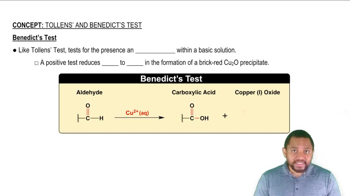
Benedict's Test Concept 3

Reducing Sugars

Reducing sugars are carbohydrates that have a free aldehyde or ketone group capable of acting as a reducing agent. Common examples include monosaccharides like glucose and fructose, as well as some disaccharides like maltose. These sugars can participate in redox reactions, making them detectable by tests like Benedict's.
추천 영상:
가이드 코스
1:03
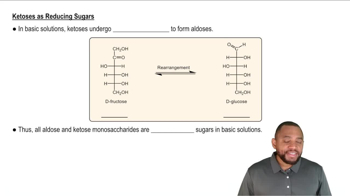
Ketoses as Reducing Sugars Concept 2

D-Glucose

D-glucose is a simple sugar and a primary energy source for cells. It is a six-carbon aldose that readily participates in reducing reactions due to its free aldehyde group. As a reducing sugar, d-glucose will yield a positive result in a Benedict's test, indicating its presence in a solution.
추천 영상:
가이드 코스
2:48
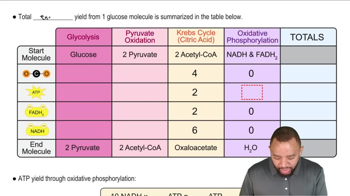
Total Energy From Glucose Concept 2