
Ch.21 The Generation of Biochemical Energy
McMurry - Fundamentals of General, Organic, and Biological Chemistry 8th Edition
McMurry8th EditionFundamentals of General, Organic, and Biological ChemistryISBN: 9780134015187당신이 사용하는 게 아니라요?교과서 변경
21장, 문제 24b

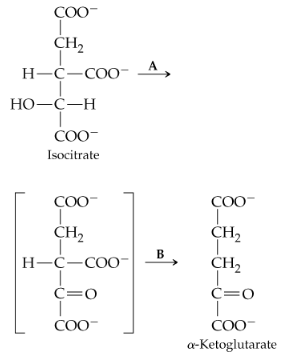
The reaction that follows is catalyzed by isocitrate dehydrogenase and occurs in two steps, the first of which (step A) is formation of an unstable intermediates (shown in brackets).

b. In which step is CO2 evolved and a hydrogen ion added?

검증된 단계별 안내
1
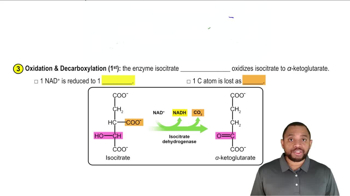
Step 1: Understand the reaction context. The reaction involves isocitrate dehydrogenase, an enzyme that catalyzes the oxidative decarboxylation of isocitrate to α-ketoglutarate in the citric acid cycle. This reaction occurs in two steps: (A) formation of an unstable intermediate and (B) subsequent decarboxylation.
Step 2: Analyze the reaction mechanism. In step A, isocitrate undergoes oxidation, facilitated by the enzyme, to form an unstable intermediate. This step does not involve the release of CO₂ or the addition of a hydrogen ion.
Step 3: Focus on step B. In this step, the unstable intermediate undergoes decarboxylation, which means a carbon dioxide (CO₂) molecule is released. Additionally, a hydrogen ion (H⁺) is added to the reaction system as part of the process.
Step 4: Identify the role of cofactors. During this reaction, NAD⁺ (or NADP⁺ in some cases) acts as an electron acceptor, becoming reduced to NADH (or NADPH) as it gains electrons and a proton (H⁺). This is a key part of the reaction mechanism.
Step 5: Conclude that CO₂ evolution and H⁺ addition occur in step B, which is the decarboxylation step. This step is critical for the progression of the citric acid cycle and energy production in cellular metabolism.

비슷한 문제에 대한 검증된 영상 답변:

이 영상 해법은 위 문제에 도움이 된다고 튜터들이 추천한 것입니다.
영상 길이:
1m

주요 개념

질문에 올바르게 답하기 위해 반드시 이해해야 하는 핵심 개념들은 다음과 같습니다.

Isocitrate Dehydrogenase

Isocitrate dehydrogenase is an enzyme that plays a crucial role in the citric acid cycle (Krebs cycle) by catalyzing the oxidative decarboxylation of isocitrate to alpha-ketoglutarate. This reaction is significant for energy production in cellular respiration, as it facilitates the conversion of isocitrate into a more energy-rich compound while releasing carbon dioxide (CO₂) as a byproduct.
추천 영상:
가이드 코스
1:47
Phase B - Succinyl CoA Formation Concept 5

Decarboxylation

Decarboxylation is a chemical reaction that involves the removal of a carboxyl group (-COOH) from a molecule, resulting in the release of carbon dioxide (CO₂). In the context of the citric acid cycle, this process is essential for transforming substrates into more reactive forms, contributing to the overall energy yield of cellular metabolism.
추천 영상:
가이드 코스
2:21
Naming Dicarboxylic Acids Concept 3

Hydrogen Ion Addition

The addition of a hydrogen ion (H⁺) during biochemical reactions often indicates a reduction process, where a substrate gains electrons. In the context of the reaction catalyzed by isocitrate dehydrogenase, the addition of H⁺ can be associated with the conversion of isocitrate to alpha-ketoglutarate, highlighting the importance of electron transfer in metabolic pathways.
추천 영상:
가이드 코스
2:55
Addition Reactions Concept 1
관련 실천
교과서 질문

The reaction that follows is catalyzed by isocitrate dehydrogenase and occurs in two steps, the first of which (step A) is formation of an unstable intermediates (shown in brackets).

d. To what class of enzymes does isocitrate dehydrogenase, the enzyme that catalyzes this reaction, belong?

1217
views
교과서 질문

For the first step in fatty acid catabolism, we say that ATP is used to “drive” the reaction that links the fatty acid with coenzyme-A. Without ATP hydrolysis, would you predict that the linking of fatty acid to coenzyme-A would be ­exergonic or endergonic? In fatty acid CoA synthesis, the hydrolysis of the ATP portion is based on what major strategy of metabolism?

997
views
교과서 질문

The reaction that follows is catalyzed by isocitrate dehydrogenase and occurs in two steps, the first of which (step A) is formation of an unstable intermediates (shown in brackets).

a. In which step is a coenzyme needed? Identify the coenzyme.

834
views
교과서 질문

Since no molecular oxygen participates in the citric acid cycle, the steps in which acetyl groups are oxidized to CO2 involve removal of hydride ions and hydrogen ions. What is the acceptor of hydride ions? What is the acceptor of hydrogen ions?

661
views
교과서 질문

The electron-transport chain uses several different metal ions, especially iron, copper, zinc, and manganese. Why are metals used frequently in these two pathways? What can metals do better than organic biomolecules?

1265
views
교과서 질문

The reaction that follows is catalyzed by isocitrate dehydrogenase and occurs in two steps, the first of which (step A) is formation of an unstable intermediates (shown in brackets).

c. Which of the structures shown can be described as a β-keto acid?

586
views