A compound with the formula C5H10O oxidizes to give 3-pentanone. Draw the condensed structural formula and give the IUPAC name for the compound.
Ch.12 Alcohols, Thiols, Ethers, Aldehydes, and Ketones
Timberlake13th EditionChemistry: An Introduction to General, Organic, and Biological ChemistryISBN: 9780134421353당신이 사용하는 게 아니라요?교과서 변경
12장, 문제 65
A compound with the formula C4H8O is synthesized from 2-methyl-1-propanol and oxidizes easily to give a carboxylic acid. Draw the condensed structural formula and give the IUPAC name for the compound.
검증된 단계별 안내1
Identify the starting material: The problem states that the compound is synthesized from 2-methyl-1-propanol. This is an alcohol with the structure CH₃-CH(CH₃)-CH₂-OH.
Understand the reaction type: The problem mentions oxidation. Primary alcohols (like 2-methyl-1-propanol) oxidize first to aldehydes and then further to carboxylic acids. Since the compound oxidizes easily to a carboxylic acid, it must be an aldehyde.
Determine the structure of the aldehyde: Oxidation of 2-methyl-1-propanol removes two hydrogen atoms (one from the hydroxyl group and one from the carbon bonded to it) to form an aldehyde. The resulting structure is CH₃-CH(CH₃)-CHO.
Name the compound using IUPAC rules: The parent chain is the longest continuous chain containing the aldehyde group. This chain has three carbons, so the base name is 'propanal.' The methyl group on the second carbon makes the name 2-methylpropanal.
Verify the oxidation to a carboxylic acid: When 2-methylpropanal undergoes further oxidation, the aldehyde group (-CHO) is converted to a carboxylic acid group (-COOH), resulting in 2-methylpropanoic acid. This confirms the compound's ability to oxidize easily to a carboxylic acid.

비슷한 문제에 대한 검증된 영상 답변:
이 영상 해법은 위 문제에 도움이 된다고 튜터들이 추천한 것입니다.
도움이 되었나요?
주요 개념
질문에 올바르게 답하기 위해 반드시 이해해야 하는 핵심 개념들은 다음과 같습니다.
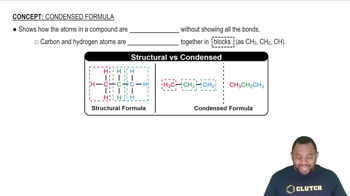
Condensed Structural Formula
A condensed structural formula is a way of representing a chemical compound that shows the arrangement of atoms in a molecule without depicting all the bonds explicitly. It typically groups atoms together to indicate how they are connected, making it easier to visualize the structure of the compound. For example, in the case of C₄H₈O, the condensed formula would reflect the specific arrangement of carbon, hydrogen, and oxygen atoms.
추천 영상:
가이드 코스
Condensed Formula Concept 1
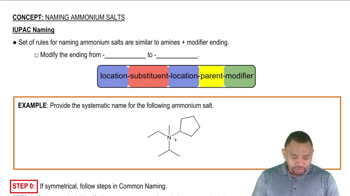
IUPAC Nomenclature
IUPAC nomenclature is a systematic method for naming chemical compounds based on their structure and functional groups. It provides a unique name that conveys information about the molecular structure, including the number of carbon atoms and the presence of functional groups like alcohols or carboxylic acids. Understanding IUPAC rules is essential for accurately naming compounds such as the one derived from 2-methyl-1-propanol.
추천 영상:
가이드 코스
IUPAC Naming Concept 3
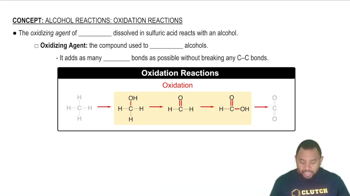
Oxidation of Alcohols
The oxidation of alcohols involves the conversion of alcohols into carbonyl compounds or carboxylic acids through the addition of oxygen or the removal of hydrogen. In this context, 2-methyl-1-propanol can be oxidized to form a carboxylic acid, which is a key aspect of understanding the reactivity of alcohols. This process is significant in organic chemistry as it helps in synthesizing various functional groups.
추천 영상:
가이드 코스
Alcohol Reactions: Oxidation Concept 1
관련 실천
교과서 질문
745
views
교과서 질문
Draw the condensed structural formulas and give the IUPAC names for all the aldehydes and ketones that have the formula C5H10O. (12.3)
920
views
교과서 질문
Compound A is a primary alcohol whose formula is C3H8O. When compound A is heated with strong acid, it dehydrates to form compound B (C3H6). When compound A is oxidized, compound C (C3H6O) forms. Draw the condensed structural formulas and give the IUPAC names for compounds A, B, and C.
1020
views
교과서 질문
Draw the condensed structural formulas and give the IUPAC names for all the alcohols that have the formula C5H12O.
866
views
교과서 질문
Draw the condensed structural or line-angle formula for the ketone or carboxylic acid product when each of the following is oxidized:
d.
52
views