Ch.12 Alcohols, Thiols, Ethers, Aldehydes, and Ketones
Timberlake - Chemistry: An Introduction to General, Organic, and Biological Chemistry 13th Edition
Timberlake13th EditionChemistry: An Introduction to General, Organic, and Biological ChemistryISBN: 9780134421353당신이 사용하는 게 아니라요?교과서 변경
12장, 문제 54b

Draw the condensed structural or line-angle formula for the alcohol produced when hydrogen and a nickel catalyst reduce each of the following:
b.

검증된 단계별 안내
1
Identify the functional group in the given compound. In this case, the compound likely contains a carbonyl group (C=O), as alcohols are typically produced by the reduction of aldehydes or ketones.
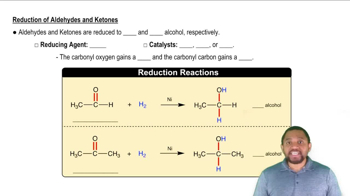
Understand the reduction process. When a carbonyl group is reduced using hydrogen (H₂) and a nickel catalyst, the double bond between carbon and oxygen is broken, and two hydrogen atoms are added. This converts the carbonyl group into a hydroxyl group (-OH), forming an alcohol.
Determine the type of alcohol produced. If the carbonyl group is part of an aldehyde, the reduction will produce a primary alcohol. If the carbonyl group is part of a ketone, the reduction will produce a secondary alcohol.
Draw the condensed structural formula or line-angle formula for the alcohol. Replace the carbonyl group in the original structure with a hydroxyl group (-OH) and ensure the correct number of hydrogens are added to maintain the valency of carbon.
Verify the structure. Check that the resulting alcohol structure is consistent with the original compound and the reduction process, ensuring all bonds and atoms are correctly represented.

비슷한 문제에 대한 검증된 영상 답변:

이 영상 해법은 위 문제에 도움이 된다고 튜터들이 추천한 것입니다.
도움이 되었나요?

주요 개념

질문에 올바르게 답하기 위해 반드시 이해해야 하는 핵심 개념들은 다음과 같습니다.

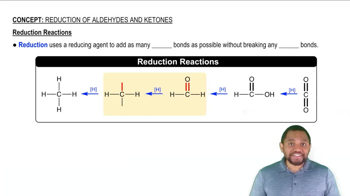
Reduction Reaction

A reduction reaction involves the gain of electrons or hydrogen by a molecule, resulting in a decrease in oxidation state. In organic chemistry, this often refers to the conversion of carbonyl compounds (like aldehydes or ketones) into alcohols. The process typically requires a reducing agent, such as hydrogen gas in the presence of a catalyst like nickel, to facilitate the reaction.
추천 영상:
가이드 코스
2:38
Reduction Reactions Concept 1

Nickel Catalyst

A nickel catalyst is a substance that accelerates the rate of a chemical reaction without being consumed in the process. In hydrogenation reactions, nickel serves as a catalyst to facilitate the addition of hydrogen to unsaturated organic compounds, effectively converting them into saturated compounds, such as alcohols from carbonyls. Its effectiveness is due to its ability to adsorb hydrogen and the organic substrate, allowing for easier interaction.
추천 영상:
가이드 코스
1:57
Reduction of Aldehydes and Ketones Concept 2

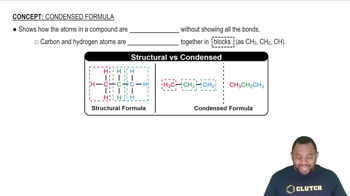
Condensed Structural Formula

A condensed structural formula is a way of representing a chemical structure that shows the arrangement of atoms in a molecule without depicting all the bonds explicitly. It provides a simplified view of the molecule, often grouping atoms together to indicate how they are connected. This format is particularly useful for illustrating organic compounds, such as alcohols, where functional groups play a significant role in the molecule's properties.
추천 영상:
가이드 코스
1:53
Condensed Formula Concept 1