Ch.12 Alcohols, Thiols, Ethers, Aldehydes, and Ketones
Timberlake - Chemistry: An Introduction to General, Organic, and Biological Chemistry 13th Edition
Timberlake13th EditionChemistry: An Introduction to General, Organic, and Biological ChemistryISBN: 9780134421353당신이 사용하는 게 아니라요?교과서 변경
12장, 문제 50b

Which compound in each pair would be more soluble in water? Explain.
b. 2-propanol or 2-pentanol

검증된 단계별 안내
1
Identify the key factor that affects solubility in water: the ability of a compound to form hydrogen bonds with water molecules. Compounds with more polar functional groups or smaller nonpolar regions tend to be more soluble in water.
Examine the structures of 2-propanol and 2-pentanol. Both are alcohols, meaning they have a hydroxyl group (-OH) capable of forming hydrogen bonds with water.
Compare the hydrocarbon (nonpolar) portions of the two molecules. 2-propanol has a shorter hydrocarbon chain (3 carbons) compared to 2-pentanol (5 carbons). Longer hydrocarbon chains increase the nonpolar character of the molecule, reducing its overall solubility in water.
Conclude that 2-propanol, with its shorter hydrocarbon chain, is more soluble in water than 2-pentanol because the polar hydroxyl group has a greater influence on the molecule's overall polarity.
To summarize, the solubility difference arises because the shorter nonpolar region in 2-propanol allows for better interaction with water molecules through hydrogen bonding, making it more water-soluble than 2-pentanol.

비슷한 문제에 대한 검증된 영상 답변:

이 영상 해법은 위 문제에 도움이 된다고 튜터들이 추천한 것입니다.
도움이 되었나요?

주요 개념

질문에 올바르게 답하기 위해 반드시 이해해야 하는 핵심 개념들은 다음과 같습니다.

Polarity

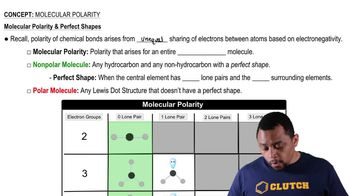
Polarity refers to the distribution of electrical charge over the atoms in a molecule. Polar molecules, which have a significant difference in electronegativity between their atoms, tend to dissolve well in water due to hydrogen bonding. In contrast, nonpolar molecules do not interact favorably with water, leading to lower solubility.
추천 영상:
가이드 코스
01:34
Molecular Polarity (Simplified) Concept 1

Hydrogen Bonding

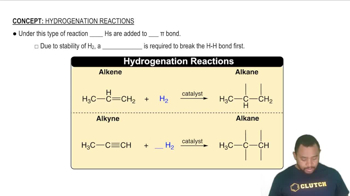
Hydrogen bonding is a type of dipole-dipole interaction that occurs when a hydrogen atom covalently bonded to a highly electronegative atom, like oxygen, interacts with another electronegative atom. This interaction significantly increases the solubility of compounds in water, as water itself is a polar solvent capable of forming hydrogen bonds.
추천 영상:
가이드 코스
1:22
Hydrogenation Reactions Concept 1

Chain Length and Solubility

The chain length of alcohols affects their solubility in water. Shorter-chain alcohols, like 2-propanol, are generally more soluble due to their higher polarity and ability to form hydrogen bonds with water. In contrast, longer-chain alcohols, such as 2-pentanol, have increased hydrophobic character, which reduces their overall solubility in water.
추천 영상:
가이드 코스
00:28
Solubility Rules