Ch.15 Lipids
Timberlake - Chemistry: An Introduction to General, Organic, and Biological Chemistry 13th Edition
Timberlake13th EditionChemistry: An Introduction to General, Organic, and Biological ChemistryISBN: 9780134421353당신이 사용하는 게 아니라요?교과서 변경
15장, 문제 32

Use condensed structural formulas to write the balanced chemical equation for the hydrogenation of glyceryl trilinolenate, a fat containing glycerol and three linolenic acid molecules.

검증된 단계별 안내
1
Identify the structure of glyceryl trilinolenate. Glyceryl trilinolenate is a triester formed from glycerol (C₃H₈O₃) and three linolenic acid molecules (C₁₈H₃₀O₂). Linolenic acid is an unsaturated fatty acid with three double bonds in its hydrocarbon chain.
Write the condensed structural formula for glyceryl trilinolenate. The structure will include a glycerol backbone with three linolenic acid chains attached via ester bonds. Each linolenic acid chain will have three double bonds, represented as -CH=CH- in the formula.
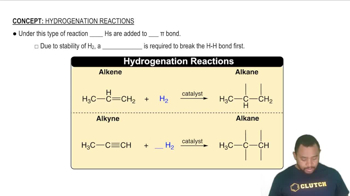
Understand the hydrogenation reaction. Hydrogenation involves the addition of hydrogen (H₂) to the double bonds in the unsaturated fatty acid chains, converting them into single bonds. This process turns the unsaturated fat into a more saturated fat.
Write the reactants for the balanced equation. The reactants will include glyceryl trilinolenate and hydrogen gas (H₂). For each double bond in the molecule, one molecule of H₂ is required. Since each linolenic acid chain has three double bonds and there are three chains, a total of 9 H₂ molecules are needed.
Write the products for the balanced equation. The products will include the fully hydrogenated form of glyceryl trilinolenate, where all double bonds in the fatty acid chains are converted to single bonds. Represent the saturated fatty acid chains in the condensed structural formula accordingly. Combine the reactants and products to write the balanced chemical equation.

비슷한 문제에 대한 검증된 영상 답변:

이 영상 해법은 위 문제에 도움이 된다고 튜터들이 추천한 것입니다.
영상 길이:
5m
도움이 되었나요?

주요 개념

질문에 올바르게 답하기 위해 반드시 이해해야 하는 핵심 개념들은 다음과 같습니다.

Hydrogenation

Hydrogenation is a chemical reaction that involves the addition of hydrogen (H2) to an unsaturated compound, typically alkenes or alkynes, converting them into saturated compounds. In the context of fats and oils, hydrogenation is used to solidify liquid oils by breaking double bonds in fatty acids, which can alter their physical properties and stability.
추천 영상:
가이드 코스
1:22
Hydrogenation Reactions Concept 1

Condensed Structural Formula

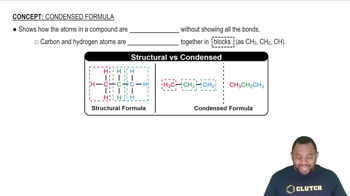
A condensed structural formula is a way of representing a chemical compound that shows the arrangement of atoms and the connectivity between them without depicting all the bonds explicitly. This notation simplifies complex molecules, making it easier to visualize their structure and understand their chemical behavior, especially in reactions like hydrogenation.
추천 영상:
가이드 코스
1:53
Condensed Formula Concept 1

Balanced Chemical Equation

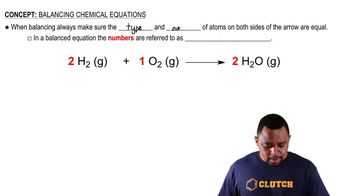
A balanced chemical equation represents a chemical reaction where the number of atoms for each element is the same on both the reactant and product sides. Balancing equations is crucial for obeying the law of conservation of mass, ensuring that matter is neither created nor destroyed during a reaction. This is essential for accurately describing the stoichiometry of the reaction, such as in the hydrogenation of glyceryl trilinolenate.
추천 영상:
가이드 코스
01:32
Balancing Chemical Equations (Simplified) Concept 1