Ch.15 Lipids
Timberlake - Chemistry: An Introduction to General, Organic, and Biological Chemistry 13th Edition
Timberlake13th EditionChemistry: An Introduction to General, Organic, and Biological ChemistryISBN: 9780134421353당신이 사용하는 게 아니라요?교과서 변경
15장, 문제 59

What is the function of the lipid bilayer in a cell membrane?

검증된 단계별 안내
1
The lipid bilayer is a fundamental component of the cell membrane, composed primarily of phospholipids arranged in two layers. Each phospholipid molecule has a hydrophilic (water-attracting) head and two hydrophobic (water-repelling) tails.
The hydrophilic heads face outward toward the aqueous environments both inside and outside the cell, while the hydrophobic tails face inward, away from water, creating a semi-permeable barrier.
This structure allows the lipid bilayer to regulate the movement of substances into and out of the cell, permitting selective permeability. Small, nonpolar molecules (e.g., oxygen and carbon dioxide) can diffuse through the bilayer, while larger or charged molecules require specific transport mechanisms.
The lipid bilayer also provides fluidity and flexibility to the membrane, enabling the cell to change shape, grow, and divide. This fluidity is influenced by factors such as the presence of cholesterol and the degree of saturation of the fatty acid tails.
Additionally, the lipid bilayer serves as a platform for membrane proteins, which are embedded within or associated with the bilayer. These proteins perform various functions, such as transport, signaling, and cell recognition, contributing to the overall functionality of the cell membrane.

비슷한 문제에 대한 검증된 영상 답변:

이 영상 해법은 위 문제에 도움이 된다고 튜터들이 추천한 것입니다.
영상 길이:
3m
도움이 되었나요?

주요 개념

질문에 올바르게 답하기 위해 반드시 이해해야 하는 핵심 개념들은 다음과 같습니다.

Lipid Bilayer Structure

The lipid bilayer is composed of two layers of phospholipids, with hydrophilic (water-attracting) heads facing outward and hydrophobic (water-repelling) tails facing inward. This arrangement creates a semi-permeable membrane that allows certain substances to pass while blocking others, maintaining the internal environment of the cell.
추천 영상:
가이드 코스
1:09
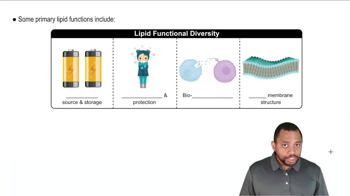
Intro to Lipids Concept 2

Cell Membrane Function

The cell membrane serves as a barrier that separates the interior of the cell from the external environment. It regulates the movement of ions, nutrients, and waste products in and out of the cell, playing a crucial role in maintaining homeostasis and facilitating communication between cells.
추천 영상:
가이드 코스
1:00
Cell Membranes Example 1

Fluid Mosaic Model

The fluid mosaic model describes the cell membrane as a dynamic and flexible structure where various proteins float in or on the fluid lipid bilayer. This model emphasizes the diverse functions of membrane proteins, including transport, signaling, and structural support, contributing to the overall functionality of the cell membrane.
추천 영상:
가이드 코스
00:34
Molecular Models Example 1