Ch.16 Amino Acids, Proteins, and Enzymes
Timberlake - Chemistry: An Introduction to General, Organic, and Biological Chemistry 13th Edition
Timberlake13th EditionChemistry: An Introduction to General, Organic, and Biological ChemistryISBN: 9780134421353당신이 사용하는 게 아니라요?교과서 변경
16장, 문제 47d

Indicate whether each of the following describes a competitive or a noncompetitive enzyme inhibitor:
d. The structure of the inhibitor is not similar to the substrate.

검증된 단계별 안내
1
Understand the difference between competitive and noncompetitive enzyme inhibitors: Competitive inhibitors resemble the substrate and compete for the active site, while noncompetitive inhibitors bind to a different site on the enzyme and do not resemble the substrate.
Analyze the given statement: 'The structure of the inhibitor is not similar to the substrate.' This indicates that the inhibitor does not compete with the substrate for the active site.
Recall that noncompetitive inhibitors bind to an allosteric site (a site other than the active site) and alter the enzyme's activity without directly blocking the substrate binding.
Conclude that since the inhibitor's structure is not similar to the substrate, it is likely describing a noncompetitive inhibitor.
Summarize the reasoning: The lack of structural similarity to the substrate suggests that the inhibitor does not compete for the active site, which aligns with the characteristics of a noncompetitive inhibitor.

비슷한 문제에 대한 검증된 영상 답변:

이 영상 해법은 위 문제에 도움이 된다고 튜터들이 추천한 것입니다.
영상 길이:
1m
도움이 되었나요?

주요 개념

질문에 올바르게 답하기 위해 반드시 이해해야 하는 핵심 개념들은 다음과 같습니다.

Competitive Inhibition

Competitive inhibition occurs when an inhibitor resembles the substrate and competes for binding to the active site of an enzyme. This type of inhibition can be overcome by increasing the concentration of the substrate, as the inhibitor and substrate vie for the same binding site. The presence of a competitive inhibitor increases the apparent Km (Michaelis constant) of the enzyme but does not affect the maximum reaction velocity (Vmax).
추천 영상:
가이드 코스
1:19
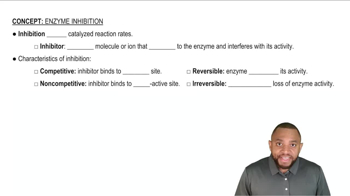
Enzyme Inhibition Concept 1

Noncompetitive Inhibition

Noncompetitive inhibition happens when an inhibitor binds to an enzyme at a site other than the active site, altering the enzyme's function regardless of substrate presence. This type of inhibition cannot be overcome by increasing substrate concentration, as the inhibitor affects the enzyme's activity directly. Noncompetitive inhibitors decrease the maximum reaction velocity (Vmax) without changing the Km.
추천 영상:
가이드 코스
1:19
Enzyme Inhibition Concept 1

Enzyme Inhibition

Enzyme inhibition refers to the process by which a molecule decreases the activity of an enzyme, thereby reducing the rate of a biochemical reaction. Inhibitors can be classified as competitive or noncompetitive based on their binding characteristics and effects on enzyme kinetics. Understanding the type of inhibition is crucial for predicting how changes in substrate or inhibitor concentrations will affect enzyme activity.
추천 영상:
가이드 코스
1:19
Enzyme Inhibition Concept 1