Ch.18 Metabolic Pathways and ATP Production
Timberlake - Chemistry: An Introduction to General, Organic, and Biological Chemistry 13th Edition
Timberlake13th EditionChemistry: An Introduction to General, Organic, and Biological ChemistryISBN: 9780134421353당신이 사용하는 게 아니라요?교과서 변경
18장, 문제 47

How is NADH oxidized in electron transport?

검증된 단계별 안내
1
Understand the role of NADH in cellular respiration: NADH is a coenzyme that acts as an electron carrier, transferring electrons to the electron transport chain (ETC) in the mitochondria.
Identify the location of the electron transport chain: The ETC is located in the inner mitochondrial membrane, where a series of protein complexes facilitate electron transfer.
Describe the oxidation process: NADH is oxidized to NAD⁺ at Complex I (NADH dehydrogenase) of the ETC. This involves the transfer of two electrons from NADH to Complex I.
Explain the movement of electrons: The electrons from NADH are passed through a series of protein complexes (Complex I, III, and IV) and mobile carriers (like ubiquinone and cytochrome c), creating a flow of electrons down the chain.
Discuss the final electron acceptor: At the end of the ETC, the electrons are transferred to oxygen (O₂), the final electron acceptor, forming water (H₂O). This process also generates a proton gradient used to produce ATP via oxidative phosphorylation.

비슷한 문제에 대한 검증된 영상 답변:

이 영상 해법은 위 문제에 도움이 된다고 튜터들이 추천한 것입니다.
영상 길이:
1m
도움이 되었나요?

주요 개념

질문에 올바르게 답하기 위해 반드시 이해해야 하는 핵심 개념들은 다음과 같습니다.

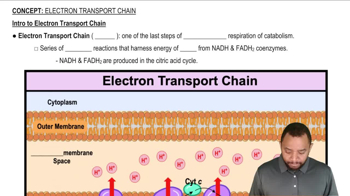
Electron Transport Chain (ETC)

The Electron Transport Chain is a series of protein complexes located in the inner mitochondrial membrane that facilitate the transfer of electrons from electron donors like NADH to electron acceptors. This process generates a proton gradient across the membrane, which is essential for ATP synthesis. The ETC is crucial for cellular respiration, as it ultimately leads to the production of ATP, the energy currency of the cell.
추천 영상:
가이드 코스
3:10
Intro to Electron Transport Chain Concept 1

Oxidation of NADH

NADH is oxidized in the Electron Transport Chain when it donates electrons to Complex I (NADH dehydrogenase). This oxidation process converts NADH back to NAD+, allowing it to participate in glycolysis and the citric acid cycle again. The electrons from NADH are then passed through various complexes in the ETC, ultimately reducing oxygen to form water.
추천 영상:
가이드 코스
0:51
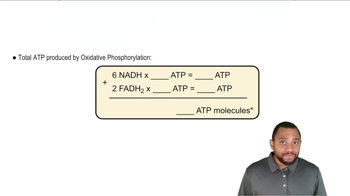
Oxidative Phosphorylation Concept 2

Proton Motive Force (PMF)

Proton Motive Force refers to the electrochemical gradient created by the movement of protons (H+) across the inner mitochondrial membrane during electron transport. As electrons move through the ETC, protons are pumped from the mitochondrial matrix into the intermembrane space, creating a gradient. This force drives ATP synthesis as protons flow back into the matrix through ATP synthase, coupling the energy released to the phosphorylation of ADP to form ATP.
추천 영상:
가이드 코스
01:59
Intermolecular Forces (Simplified) Concept 1