Ch.5 Nuclear Chemistry
Timberlake - Chemistry: An Introduction to General, Organic, and Biological Chemistry 13th Edition
Timberlake13th EditionChemistry: An Introduction to General, Organic, and Biological ChemistryISBN: 9780134421353당신이 사용하는 게 아니라요?교과서 변경
5장, 문제 51

In problems 5.51 to 5.54, a nucleus is shown with protons and neutrons.
Draw the new nucleus when this isotope emits a positron to complete the following:
<IMAGE>

검증된 단계별 안내
1
Step 1: Understand the process of positron emission. Positron emission occurs when a proton in the nucleus is converted into a neutron, releasing a positron (β⁺) and a neutrino. This changes the atomic number of the element but keeps the mass number the same.
Step 2: Analyze the given nucleus. Count the number of protons (orange spheres) and neutrons (black spheres) in the original nucleus. This will help determine the atomic number and mass number of the isotope before the emission.
Step 3: Determine the new nucleus after positron emission. Since a proton is converted into a neutron, the number of protons decreases by 1, and the number of neutrons increases by 1. The atomic number decreases by 1, but the mass number remains unchanged.
Step 4: Identify the new element. Use the periodic table to find the element with the new atomic number (original atomic number minus 1). This represents the new nucleus formed after positron emission.
Step 5: Draw the new nucleus. Replace one proton (orange sphere) with a neutron (black sphere) in the diagram to represent the new nucleus. Ensure the total number of particles (protons + neutrons) remains the same, but the distribution reflects the change due to positron emission.

비슷한 문제에 대한 검증된 영상 답변:

이 영상 해법은 위 문제에 도움이 된다고 튜터들이 추천한 것입니다.
영상 길이:
2m
도움이 되었나요?

주요 개념

질문에 올바르게 답하기 위해 반드시 이해해야 하는 핵심 개념들은 다음과 같습니다.

Positron Emission

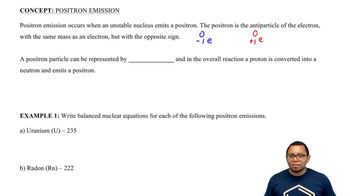
Positron emission is a type of radioactive decay in which a proton in the nucleus is transformed into a neutron, resulting in the emission of a positron (the antimatter counterpart of an electron). This process decreases the atomic number of the element by one while keeping the mass number the same, leading to the formation of a new isotope.
추천 영상:
가이드 코스
01:54
Positron Emission Concept 1

Nuclear Structure

The nucleus of an atom is composed of protons and neutrons, collectively known as nucleons. Protons carry a positive charge, while neutrons are neutral. The balance between these particles determines the stability of the nucleus and influences the type of decay it may undergo, such as positron emission.
추천 영상:
가이드 코스
1:01
Structural Formula Concept 2

Isotopes

Isotopes are variants of a chemical element that have the same number of protons but different numbers of neutrons. This difference in neutron count results in varying atomic masses. Isotopes can be stable or unstable, with unstable isotopes undergoing radioactive decay, such as positron emission, to achieve a more stable configuration.
추천 영상: