Ch.6 Ionic and Molecular Compounds
Timberlake - Chemistry: An Introduction to General, Organic, and Biological Chemistry 13th Edition
Timberlake13th EditionChemistry: An Introduction to General, Organic, and Biological ChemistryISBN: 9780134421353당신이 사용하는 게 아니라요?교과서 변경
6장, 문제 152b

Classify each of the following as ionic or molecular, and name each:
b. Cl2O7

검증된 단계별 안내
1
Step 1: Determine if the compound is ionic or molecular. Ionic compounds are formed between metals and nonmetals, while molecular compounds are formed between nonmetals. Cl₂O₇ consists of chlorine (Cl) and oxygen (O), both of which are nonmetals, so it is a molecular compound.
Step 2: Identify the type of molecular compound. Cl₂O₇ is a binary molecular compound, meaning it consists of two different nonmetal elements.
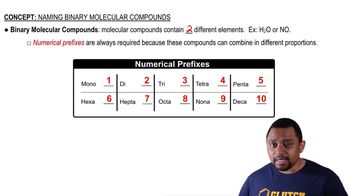
Step 3: Apply the rules for naming molecular compounds. Use prefixes to indicate the number of atoms of each element. The prefix 'di-' is used for two chlorine atoms, and the prefix 'hepta-' is used for seven oxygen atoms.
Step 4: Combine the prefixes with the element names. The name of the first element (chlorine) remains unchanged, while the second element (oxygen) ends with '-ide.' This gives 'dichlorine heptoxide.'
Step 5: Verify the name and classification. The compound is molecular, and its name is 'dichlorine heptoxide,' following the standard naming conventions for molecular compounds.

비슷한 문제에 대한 검증된 영상 답변:

이 영상 해법은 위 문제에 도움이 된다고 튜터들이 추천한 것입니다.
영상 길이:
1m
도움이 되었나요?

주요 개념

질문에 올바르게 답하기 위해 반드시 이해해야 하는 핵심 개념들은 다음과 같습니다.

Ionic Compounds

Ionic compounds are formed through the electrostatic attraction between positively charged ions (cations) and negatively charged ions (anions). They typically consist of a metal and a non-metal, where the metal donates electrons to the non-metal, resulting in a transfer of charge. This leads to the formation of a crystalline structure with high melting and boiling points.
추천 영상:
가이드 코스
02:11
Naming Ionic Compounds

Molecular Compounds

Molecular compounds are formed when two or more non-metals share electrons through covalent bonds. These compounds can exist as discrete molecules and often have lower melting and boiling points compared to ionic compounds. They can be classified based on the number of atoms involved, such as diatomic or polyatomic molecules.
추천 영상:
가이드 코스
01:10
Naming Binary Molecular Compounds Concept 1

Naming Conventions

The naming of ionic and molecular compounds follows specific conventions. Ionic compounds are named by combining the names of the cation and anion, often with the anion ending in '-ide' for simple ions. Molecular compounds use prefixes (mono-, di-, tri-, etc.) to indicate the number of atoms of each element, with the second element typically ending in '-ide'.
추천 영상:
가이드 코스
0:36
Rules for Naming Thiols Concept 1