Ch.6 Ionic and Molecular Compounds
Timberlake - Chemistry: An Introduction to General, Organic, and Biological Chemistry 13th Edition
Timberlake13th EditionChemistry: An Introduction to General, Organic, and Biological ChemistryISBN: 9780134421353당신이 사용하는 게 아니라요?교과서 변경
6장, 문제 112c

Consider an ion with the symbol Y3- formed from a representative element.
c. If Y is in Period 3, what is the element?

검증된 단계별 안내
1
Identify the charge of the ion, which is 3⁻. This indicates that the element has gained 3 electrons to form the ion.
Determine the number of valence electrons in the neutral atom of the element. Since the ion has gained 3 electrons, the neutral atom must have had 5 valence electrons to reach a full octet (8 valence electrons).
Locate the group in the periodic table that corresponds to 5 valence electrons. Elements with 5 valence electrons are in Group 15 (or Group 5A in older notation).
Focus on Period 3 of the periodic table, as the problem specifies that the element is in Period 3. The element in Group 15 and Period 3 is phosphorus (P).
Conclude that the element Y is phosphorus (P), and the ion Y³⁻ corresponds to the phosphide ion (P³⁻).

비슷한 문제에 대한 검증된 영상 답변:

이 영상 해법은 위 문제에 도움이 된다고 튜터들이 추천한 것입니다.
영상 길이:
3m
도움이 되었나요?

주요 개념

질문에 올바르게 답하기 위해 반드시 이해해야 하는 핵심 개념들은 다음과 같습니다.

Ion Formation

Ions are charged particles that form when atoms gain or lose electrons. A cation has a positive charge due to the loss of electrons, while an anion has a negative charge from gaining electrons. In this case, Y³⁻ indicates that the element has gained three electrons, resulting in a negative charge.
추천 영상:
가이드 코스
1:41
Amide Formation Concept 1

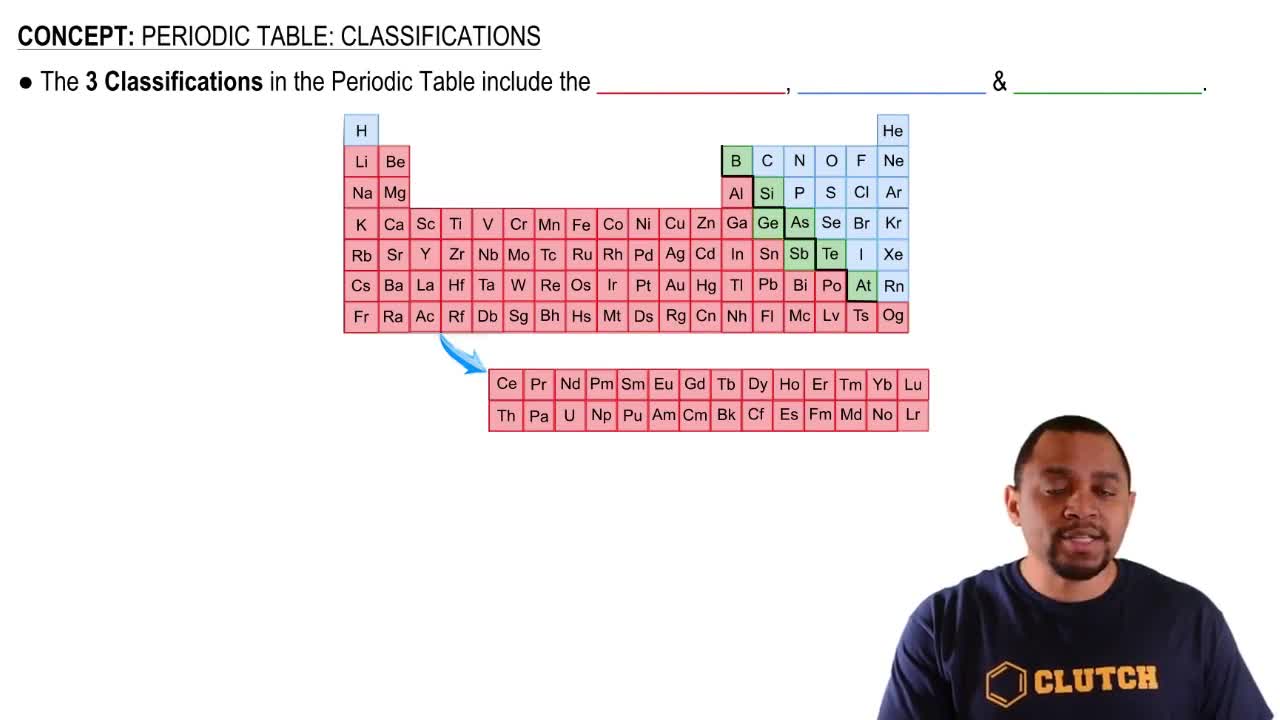
Periodic Table and Periods

The periodic table organizes elements based on their atomic number and properties. Each horizontal row is called a period, and elements in the same period share similar energy levels. Period 3 includes elements such as sodium, magnesium, and sulfur, which are crucial for identifying the element Y.
추천 영상:
가이드 코스
02:40
Periodic Table: Classifications

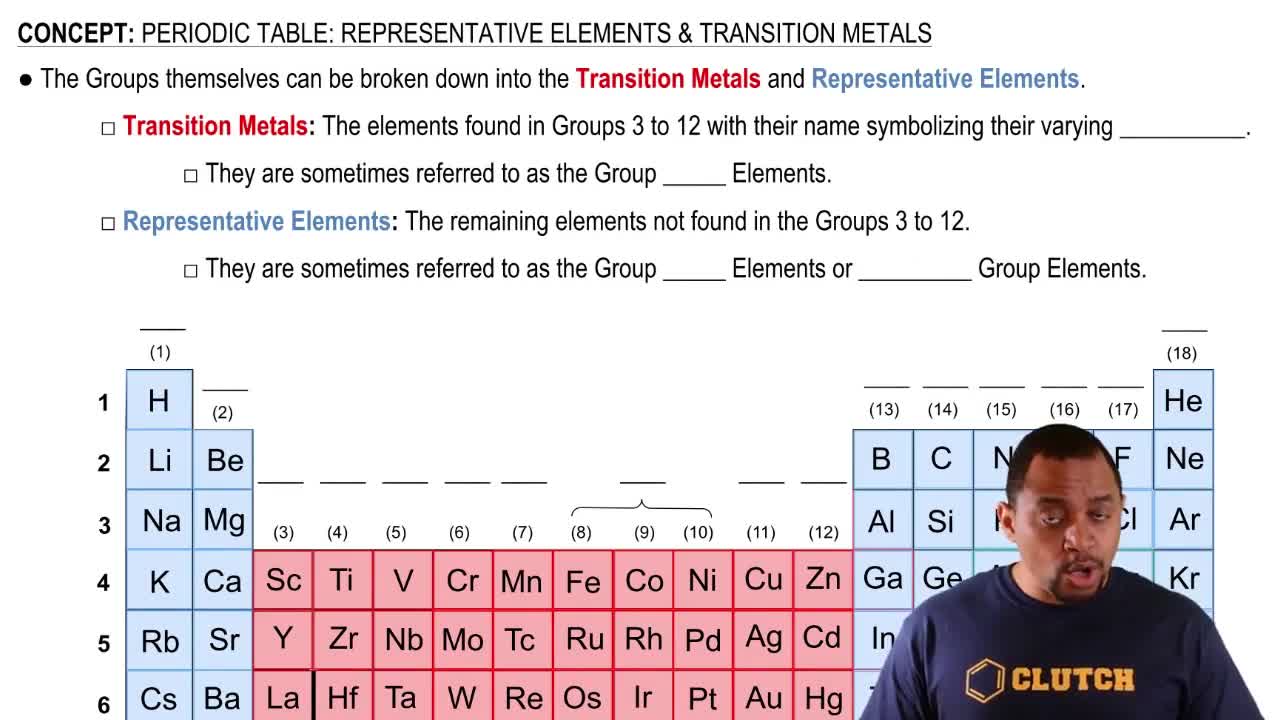
Representative Elements

Representative elements, also known as main group elements, are found in groups 1, 2, and 13-18 of the periodic table. They exhibit a wide range of chemical and physical properties and typically form predictable ions. Understanding that Y is a representative element helps narrow down the possibilities for its identity in Period 3.
추천 영상:
가이드 코스
03:30
Periodic Table: Representative Elements & Transition Metals