Ch.6 Ionic and Molecular Compounds
Timberlake - Chemistry: An Introduction to General, Organic, and Biological Chemistry 13th Edition
Timberlake13th EditionChemistry: An Introduction to General, Organic, and Biological ChemistryISBN: 9780134421353당신이 사용하는 게 아니라요?교과서 변경
6장, 문제 17e

Write the correct ionic formula for the compound formed between each of the following pairs of ions:
e. Al3+ and S2-

검증된 단계별 안내
1
Identify the charges of the ions: Aluminum (Al) has a charge of +3 (Al³⁺), and Sulfide (S) has a charge of -2 (S²⁻).
Determine the least common multiple (LCM) of the charges to balance the total positive and negative charges. The LCM of 3 and 2 is 6.
Calculate the number of each ion needed to achieve charge neutrality. To balance the charges, you need 2 Al³⁺ ions (2 × +3 = +6) and 3 S²⁻ ions (3 × -2 = -6).
Write the formula by placing the number of each ion as subscripts after the element symbols. The formula is written as Al₂S₃, where the subscripts indicate the ratio of aluminum to sulfide ions.
Double-check the formula to ensure the total positive and negative charges are equal and the subscripts are in the simplest whole-number ratio.

비슷한 문제에 대한 검증된 영상 답변:

이 영상 해법은 위 문제에 도움이 된다고 튜터들이 추천한 것입니다.
영상 길이:
2m
도움이 되었나요?

주요 개념

질문에 올바르게 답하기 위해 반드시 이해해야 하는 핵심 개념들은 다음과 같습니다.

Ionic Compounds

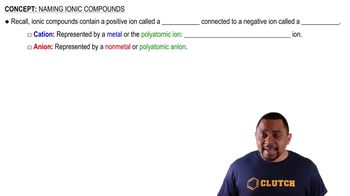
Ionic compounds are formed when positively charged ions (cations) and negatively charged ions (anions) bond together through electrostatic forces. The overall charge of the compound must be neutral, meaning the total positive charge from cations must balance the total negative charge from anions.
추천 영상:
가이드 코스
02:11
Naming Ionic Compounds

Charge Balance

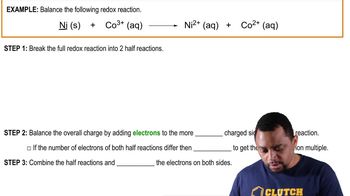
Charge balance is a fundamental principle in forming ionic compounds. Each ion carries a specific charge, and when combining ions, the total positive and negative charges must equal zero. For example, in the case of Al³⁺ (with a +3 charge) and S²⁻ (with a -2 charge), the charges must be balanced to determine the correct ratio of ions in the formula.
추천 영상:
가이드 코스
03:12
Balancing Redox Reactions (Simplified) Example 2

Empirical Formula

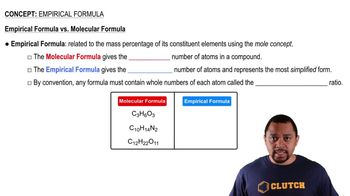
The empirical formula represents the simplest whole-number ratio of ions in an ionic compound. To derive the empirical formula from the ions Al³⁺ and S²⁻, one must find the least common multiple of their charges, which leads to the formula Al₂S₃, indicating that two aluminum ions combine with three sulfide ions to achieve charge neutrality.
추천 영상:
가이드 코스
02:26
Empirical Formula