Ch.9 Solutions
Timberlake - Chemistry: An Introduction to General, Organic, and Biological Chemistry 13th Edition
Timberlake13th EditionChemistry: An Introduction to General, Organic, and Biological ChemistryISBN: 9780134421353당신이 사용하는 게 아니라요?교과서 변경
9장, 문제 67

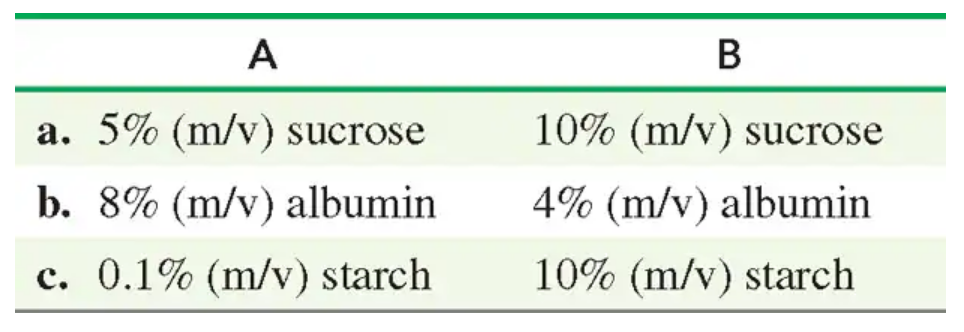
Indicate the compartment (A or B) that will increase in volume for each of the following pairs of solutions separated by a semipermeable membrane:
Table comparing solution concentrations in compartments A and B for osmosis analysis.

검증된 단계별 안내
1
Step 1: Understand the concept of osmosis. Osmosis is the movement of water across a semipermeable membrane from a region of lower solute concentration to a region of higher solute concentration.
Step 2: Analyze the solutions provided. Compartment I contains a 3% (m/v) solution of MgCl₂, while Compartment II contains a 6% (m/v) solution of MgCl₂. The semipermeable membrane allows water to pass but not solutes.
Step 3: Determine the direction of water movement. Water will move from the compartment with lower solute concentration (Compartment I) to the compartment with higher solute concentration (Compartment II) to equalize the concentrations.
Step 4: Predict the volume change. As water moves into Compartment II, its volume will increase, while the volume of Compartment I will decrease.
Step 5: Conclude that Compartment II will increase in volume due to the osmotic movement of water from Compartment I to Compartment II.

비슷한 문제에 대한 검증된 영상 답변:

이 영상 해법은 위 문제에 도움이 된다고 튜터들이 추천한 것입니다.
영상 길이:
1m
도움이 되었나요?

주요 개념

질문에 올바르게 답하기 위해 반드시 이해해야 하는 핵심 개념들은 다음과 같습니다.

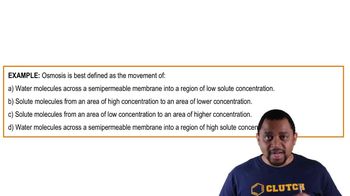
Osmosis

Osmosis is the movement of water across a semipermeable membrane from an area of lower solute concentration to an area of higher solute concentration. This process continues until equilibrium is reached, meaning the concentrations on both sides of the membrane become equal. Understanding osmosis is crucial for predicting which compartment will increase in volume when two solutions with different concentrations are separated by a membrane.
추천 영상:
가이드 코스
00:38
Osmosis Example 1

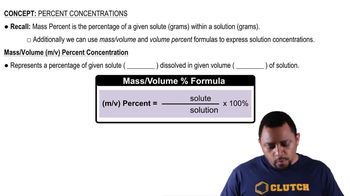
Solute Concentration

Solute concentration refers to the amount of solute present in a given volume of solution. In the context of the question, the 3% (m/v) MgCl2 solution has a lower solute concentration compared to the 6% (m/v) MgCl2 solution. The difference in solute concentration drives the osmotic movement of water, leading to volume changes in the compartments.
추천 영상:
가이드 코스
00:52
Percent Concentrations Concept 1

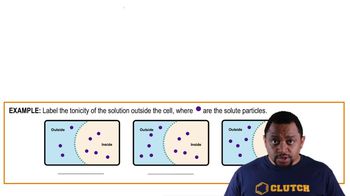
Tonicity

Tonicity describes the relative concentration of solutes in two solutions separated by a semipermeable membrane, influencing the direction of water movement. A solution can be isotonic, hypertonic, or hypotonic relative to another. In this case, the 3% MgCl2 solution is hypotonic compared to the 6% MgCl2 solution, meaning water will move from the 3% solution to the 6% solution, resulting in an increase in volume in the latter.
추천 영상:
가이드 코스
01:03
Osmosis Example 2