Ch.9 Solutions
Timberlake - Chemistry: An Introduction to General, Organic, and Biological Chemistry 13th Edition
Timberlake13th EditionChemistry: An Introduction to General, Organic, and Biological ChemistryISBN: 9780134421353당신이 사용하는 게 아니라요?교과서 변경
9장, 문제 80a

Select the container that represents the dilution of a 4% (m/v) KCl solution to give each of the following:
a. a 2% (m/v) KCl solution
<IMAGE>

검증된 단계별 안내
1
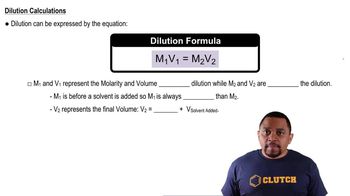
Step 1: Understand the concept of dilution. Dilution involves reducing the concentration of a solution by adding more solvent. The formula used for dilution is \( C_1V_1 = C_2V_2 \), where \( C_1 \) and \( C_2 \) are the initial and final concentrations, and \( V_1 \) and \( V_2 \) are the initial and final volumes.
Step 2: Identify the given values. The initial concentration \( C_1 \) is 4% (m/v), and the final concentration \( C_2 \) is 2% (m/v). You need to determine the volume of the original solution \( V_1 \) required to prepare the diluted solution.
Step 3: Rearrange the dilution formula to solve for \( V_1 \): \( V_1 = \frac{C_2V_2}{C_1} \). Here, \( V_2 \) represents the total volume of the diluted solution.
Step 4: Analyze the image provided. The container shown represents a solution with a specific volume. If the container is labeled or has markings indicating the total volume, use that value as \( V_2 \). If no markings are visible, assume the container's volume is the total volume of the diluted solution.
Step 5: Substitute the known values into the formula \( V_1 = \frac{C_2V_2}{C_1} \) to calculate the volume of the original 4% solution needed. Ensure the units are consistent throughout the calculation (e.g., mL or L).

비슷한 문제에 대한 검증된 영상 답변:

이 영상 해법은 위 문제에 도움이 된다고 튜터들이 추천한 것입니다.
영상 길이:
1m
도움이 되었나요?

주요 개념

질문에 올바르게 답하기 위해 반드시 이해해야 하는 핵심 개념들은 다음과 같습니다.

Dilution

Dilution is the process of reducing the concentration of a solute in a solution, typically by adding more solvent. In this context, diluting a 4% (m/v) KCl solution to a 2% (m/v) solution involves adding a specific volume of solvent to decrease the concentration of potassium chloride in the solution.
추천 영상:

Mass/Volume Percent (m/v)

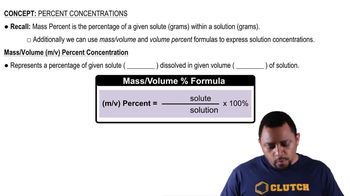
Mass/Volume Percent (m/v) is a way to express the concentration of a solution, defined as the mass of solute (in grams) per 100 mL of solution. For example, a 4% (m/v) KCl solution contains 4 grams of KCl in every 100 mL of solution, while a 2% (m/v) solution contains 2 grams of KCl in the same volume.
추천 영상:
가이드 코스
00:38
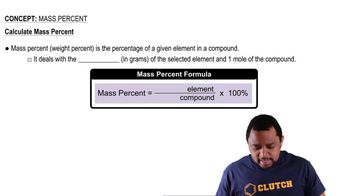
Mass Percent Concept

Concentration Calculation

Concentration calculation involves determining the amount of solute and solvent needed to achieve a desired concentration. To dilute a solution from 4% to 2%, one must calculate the appropriate volumes of the original solution and solvent required, ensuring the final concentration meets the target specifications.
추천 영상:
가이드 코스
00:52
Percent Concentrations Concept 1