Ch.15 Lipids
Timberlake - Chemistry: An Introduction to General, Organic, and Biological Chemistry 14th Edition
Timberlake14th EditionChemistry: An Introduction to General, Organic, and Biological ChemistryISBN: 9781292472249당신이 사용하는 게 아니라요?교과서 변경
15장, 문제 65b

Identify the type of transport described by each of the following:
a. A molecule moves through a protein channel.

검증된 단계별 안내
1
Step 1: Understand the concept of transport mechanisms in cells. Transport mechanisms are ways molecules move across cell membranes. They can be classified as passive transport (no energy required) or active transport (energy required).
Step 2: Recognize that the problem specifies a molecule moving through a protein channel. Protein channels are specialized structures embedded in the cell membrane that allow specific molecules or ions to pass through.
Step 3: Recall that movement through a protein channel typically occurs down the molecule's concentration gradient (from high concentration to low concentration) and does not require energy. This is a characteristic of facilitated diffusion, a type of passive transport.
Step 4: Differentiate facilitated diffusion from other types of transport. Unlike simple diffusion, facilitated diffusion requires the assistance of a protein channel to move molecules that cannot easily pass through the lipid bilayer (e.g., polar or charged molecules).
Step 5: Conclude that the type of transport described in this scenario is facilitated diffusion, as the molecule moves through a protein channel without the use of energy.

비슷한 문제에 대한 검증된 영상 답변:

이 영상 해법은 위 문제에 도움이 된다고 튜터들이 추천한 것입니다.
영상 길이:
3m
도움이 되었나요?

주요 개념

질문에 올바르게 답하기 위해 반드시 이해해야 하는 핵심 개념들은 다음과 같습니다.

Facilitated Diffusion

Facilitated diffusion is a type of passive transport that allows molecules to cross membranes with the assistance of special proteins. This process does not require energy, as molecules move down their concentration gradient, from areas of higher concentration to lower concentration. Protein channels specifically facilitate the movement of larger or polar molecules that cannot easily pass through the lipid bilayer.
추천 영상:
가이드 코스
1:23
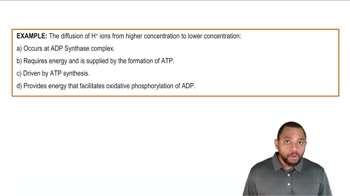
Oxidative Phosphorylation Example 1

Protein Channels

Protein channels are integral membrane proteins that form pores in the cell membrane, allowing specific ions or molecules to pass through. These channels are selective, meaning they only permit certain substances to enter or exit the cell, which is crucial for maintaining cellular homeostasis. They can be gated, opening or closing in response to specific signals, thus regulating the flow of substances.
추천 영상:
가이드 코스
2:01
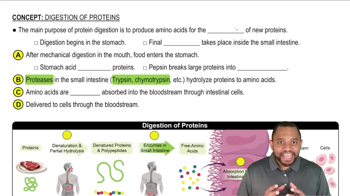
Digestion of Proteins Concept 1

Passive Transport

Passive transport is the movement of substances across a cell membrane without the use of energy. This process relies on the natural kinetic energy of molecules, allowing them to move from areas of higher concentration to areas of lower concentration. Types of passive transport include simple diffusion, facilitated diffusion, and osmosis, all of which are essential for cellular function and nutrient uptake.
추천 영상:
가이드 코스
1:21
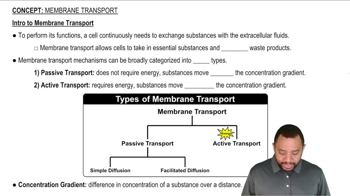
Membrane Transport Concept 1