Ch.16 Amino Acids, Proteins, and Enzymes
Timberlake - Chemistry: An Introduction to General, Organic, and Biological Chemistry 14th Edition
Timberlake14th EditionChemistry: An Introduction to General, Organic, and Biological ChemistryISBN: 9781292472249당신이 사용하는 게 아니라요?교과서 변경
16장, 문제 81c

Consider the amino acids lysine, valine, and aspartate in an enzyme. State which of these amino acids have R groups that would:
c. form hydrogen bonds

검증된 단계별 안내
1
Identify the R groups (side chains) of the given amino acids: lysine, valine, and aspartate. Lysine has an amino group (-NH3+) in its side chain, valine has a branched alkyl group, and aspartate has a carboxyl group (-COO−) in its side chain.
Recall the conditions for hydrogen bonding: Hydrogen bonds form between a hydrogen atom covalently bonded to an electronegative atom (like O, N, or F) and another electronegative atom with a lone pair of electrons.
Analyze the R group of lysine. The amino group (-NH3+) in lysine's side chain can participate in hydrogen bonding because nitrogen is electronegative and can interact with hydrogen bond acceptors or donors.
Analyze the R group of valine. The branched alkyl group in valine is nonpolar and lacks electronegative atoms, so it cannot form hydrogen bonds.
Analyze the R group of aspartate. The carboxyl group (-COO−) in aspartate's side chain contains oxygen atoms, which are electronegative and can act as hydrogen bond acceptors, allowing aspartate to form hydrogen bonds.

비슷한 문제에 대한 검증된 영상 답변:

이 영상 해법은 위 문제에 도움이 된다고 튜터들이 추천한 것입니다.
영상 길이:
6m

주요 개념

질문에 올바르게 답하기 위해 반드시 이해해야 하는 핵심 개념들은 다음과 같습니다.

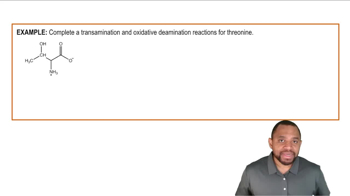
Amino Acid Structure

Amino acids are organic compounds that serve as the building blocks of proteins. Each amino acid consists of a central carbon atom, an amino group, a carboxyl group, a hydrogen atom, and a variable R group (side chain). The R group determines the unique properties of each amino acid, influencing how they interact with each other and with other molecules.
추천 영상:
가이드 코스
3:03
Amino Acid Catabolism: Amino Group Example 2

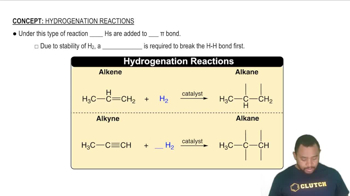
Hydrogen Bonding

Hydrogen bonds are weak attractions that occur between a hydrogen atom covalently bonded to an electronegative atom and another electronegative atom. In the context of amino acids, R groups that contain polar functional groups, such as hydroxyl (-OH) or amine (-NH2) groups, can participate in hydrogen bonding, which is crucial for protein structure and function.
추천 영상:
가이드 코스
1:22
Hydrogenation Reactions Concept 1

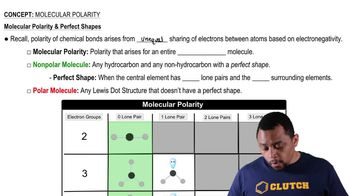
Polarity of R Groups

The polarity of an amino acid's R group affects its ability to form hydrogen bonds. Polar R groups, which have uneven distribution of electrical charge, can interact with water and other polar molecules, facilitating hydrogen bond formation. In contrast, nonpolar R groups do not engage in hydrogen bonding, impacting the overall behavior of proteins in biological systems.
추천 영상:
가이드 코스
01:34
Molecular Polarity (Simplified) Concept 1