Ch.16 Amino Acids, Proteins, and Enzymes
Timberlake - Chemistry: An Introduction to General, Organic, and Biological Chemistry 14th Edition
Timberlake14th EditionChemistry: An Introduction to General, Organic, and Biological ChemistryISBN: 9781292472249당신이 사용하는 게 아니라요?교과서 변경
16장, 문제 77

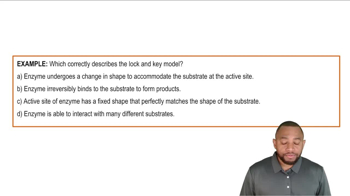
How would the lock-and-key model explain that sucrase hydrolyzes sucrose, but not lactose?

검증된 단계별 안내
1
Understand the lock-and-key model: This model explains enzyme specificity by comparing the enzyme to a lock and the substrate to a key. Only the correct substrate (key) fits into the enzyme's active site (lock).
Identify the enzyme and substrates in the problem: Sucrase is the enzyme, and sucrose and lactose are the substrates. Sucrase catalyzes the hydrolysis of sucrose but not lactose.
Analyze the structural compatibility: In the lock-and-key model, the active site of sucrase has a specific shape that matches the structure of sucrose. This structural compatibility allows sucrose to bind to the active site of sucrase.
Explain why lactose is not hydrolyzed: Lactose has a different molecular structure compared to sucrose. Because of this difference, lactose does not fit into the active site of sucrase, preventing the enzyme from catalyzing its hydrolysis.
Conclude the explanation: The lock-and-key model demonstrates that enzyme specificity is determined by the precise fit between the enzyme's active site and the substrate. Sucrase is specific to sucrose because only sucrose fits into its active site, while lactose does not.

비슷한 문제에 대한 검증된 영상 답변:

이 영상 해법은 위 문제에 도움이 된다고 튜터들이 추천한 것입니다.
영상 길이:
3m
도움이 되었나요?

주요 개념

질문에 올바르게 답하기 위해 반드시 이해해야 하는 핵심 개념들은 다음과 같습니다.

Lock-and-Key Model

The lock-and-key model is a theory that describes how enzymes interact with substrates. According to this model, the enzyme (the 'lock') has a specific shape that perfectly fits a particular substrate (the 'key'). This specificity ensures that only certain substrates can bind to the enzyme, leading to a reaction. In the case of sucrase, its active site is shaped to fit sucrose, allowing it to catalyze its hydrolysis.
추천 영상:
가이드 코스
1:26
Models of Enzyme Action Example 1

Enzyme Specificity

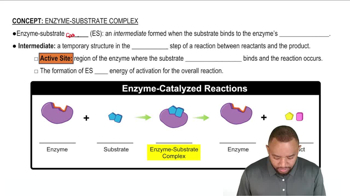
Enzyme specificity refers to the ability of an enzyme to select and catalyze a specific substrate among many possible candidates. This specificity is determined by the enzyme's active site structure, which is complementary to the substrate's shape. Sucrase is specific for sucrose due to its unique active site configuration, which does not accommodate lactose, thus preventing its hydrolysis.
추천 영상:
가이드 코스
01:37
Specific Gravity

Substrate Structure

The structure of a substrate plays a crucial role in enzyme activity. Different substrates have distinct molecular shapes and functional groups that influence their interaction with enzymes. Sucrose and lactose differ in their chemical structure; sucrase can effectively bind to sucrose due to its specific shape, while the structural differences in lactose prevent it from fitting into the active site of sucrase, illustrating the importance of substrate structure in enzymatic reactions.
추천 영상:
가이드 코스
2:32
Enzyme-Substrate Complex Concept 1