Ch.16 Amino Acids, Proteins, and Enzymes
Timberlake - Chemistry: An Introduction to General, Organic, and Biological Chemistry 14th Edition
Timberlake14th EditionChemistry: An Introduction to General, Organic, and Biological ChemistryISBN: 9781292472249당신이 사용하는 게 아니라요?교과서 변경
16장, 문제 14b

Peptides from sweet potato with antioxidant properties have the following sequence of amino acids. Draw the structure for each peptide and write the one-letter abbreviations.
b. Asn–Tyr–Asp–Glu–Tyr

검증된 단계별 안내
1
Step 1: Understand the problem. The task involves two parts: (a) drawing the structure of the peptide sequence and (b) writing the one-letter abbreviations for the amino acids in the sequence. The peptide sequence provided is Asn–Tyr–Asp–Glu–Tyr.
Step 2: Recall the structure of each amino acid. Each amino acid has a central carbon (α-carbon) bonded to an amino group (-NH₂), a carboxyl group (-COOH), a hydrogen atom, and a unique side chain (R group). For the given sequence: Asn (Asparagine), Tyr (Tyrosine), Asp (Aspartic acid), Glu (Glutamic acid), and Tyr (Tyrosine), identify the side chains for each amino acid.
Step 3: Draw the peptide bond formation. Peptide bonds are formed by a condensation reaction between the carboxyl group of one amino acid and the amino group of the next. Connect the amino acids in the sequence Asn–Tyr–Asp–Glu–Tyr by forming peptide bonds, ensuring the N-terminus (amino group) is on the left and the C-terminus (carboxyl group) is on the right.
Step 4: Write the one-letter abbreviations for the sequence. Each amino acid has a standard one-letter code: Asn = N, Tyr = Y, Asp = D, Glu = E, and Tyr = Y. Combine these to write the sequence in one-letter format.
Step 5: Verify the structure and sequence. Double-check the peptide structure to ensure all peptide bonds are correctly formed and the sequence matches the given order. Confirm the one-letter abbreviation sequence is accurate as NYDEY.

비슷한 문제에 대한 검증된 영상 답변:

이 영상 해법은 위 문제에 도움이 된다고 튜터들이 추천한 것입니다.
영상 길이:
1m

주요 개념

질문에 올바르게 답하기 위해 반드시 이해해야 하는 핵심 개념들은 다음과 같습니다.

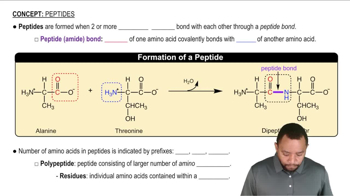
Peptide Structure

Peptides are short chains of amino acids linked by peptide bonds. The structure of a peptide is determined by the sequence of its amino acids, which influences its shape and function. Understanding how to draw peptide structures involves knowing the backbone and side chain orientations of the amino acids.
추천 영상:
가이드 코스
3:07
Peptides Concept 1

Amino Acid Abbreviations

Amino acids are represented by one-letter abbreviations, which are standardized for ease of communication in biochemistry. For example, Asparagine is represented as 'N', Tyrosine as 'Y', Aspartic acid as 'D', and Glutamic acid as 'E'. Familiarity with these abbreviations is essential for accurately conveying peptide sequences.
추천 영상:
가이드 코스
3:03
Amino Acid Catabolism: Amino Group Example 2

Antioxidant Properties of Peptides

Certain peptides possess antioxidant properties, which means they can neutralize free radicals and reduce oxidative stress in biological systems. This property is often linked to specific amino acid sequences and their ability to interact with reactive species. Understanding the relationship between peptide structure and antioxidant activity is crucial for evaluating their potential health benefits.
추천 영상:
가이드 코스
1:24
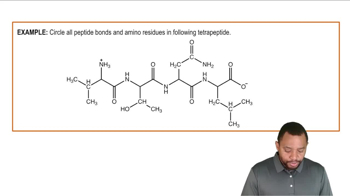
Peptides Example 1