Ch.16 Amino Acids, Proteins, and Enzymes
Timberlake - Chemistry: An Introduction to General, Organic, and Biological Chemistry 14th Edition
Timberlake14th EditionChemistry: An Introduction to General, Organic, and Biological ChemistryISBN: 9781292472249당신이 사용하는 게 아니라요?교과서 변경
16장, 문제 19

What is the difference in hydrogen bonding between an α helix and a β−pleated sheet?

검증된 단계별 안내
1
Understand the concept of hydrogen bonding: Hydrogen bonds are weak interactions between a hydrogen atom covalently bonded to an electronegative atom (like oxygen or nitrogen) and another electronegative atom. These bonds play a crucial role in stabilizing protein secondary structures such as α helices and β-pleated sheets.
Examine the α helix structure: In an α helix, hydrogen bonds form between the carbonyl oxygen (C=O) of one amino acid and the amide hydrogen (N-H) of another amino acid located four residues away in the sequence. These bonds are parallel to the axis of the helix, creating a coiled structure.
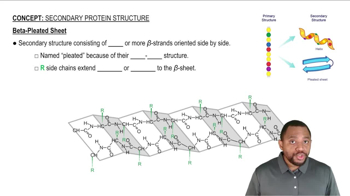
Examine the β-pleated sheet structure: In a β-pleated sheet, hydrogen bonds form between the carbonyl oxygen (C=O) of one amino acid in one strand and the amide hydrogen (N-H) of another amino acid in an adjacent strand. These bonds are perpendicular to the strands, creating a sheet-like structure.
Compare the orientation of hydrogen bonds: In an α helix, the hydrogen bonds are intramolecular (within the same polypeptide chain) and aligned parallel to the helix axis. In a β-pleated sheet, the hydrogen bonds are intermolecular (between different polypeptide chains or regions of the same chain) and aligned perpendicular to the strands.
Summarize the difference: The key difference lies in the arrangement and orientation of hydrogen bonds. In an α helix, the bonds stabilize a coiled structure within a single chain, while in a β-pleated sheet, the bonds stabilize a sheet-like structure between adjacent chains or regions.

비슷한 문제에 대한 검증된 영상 답변:

이 영상 해법은 위 문제에 도움이 된다고 튜터들이 추천한 것입니다.
영상 길이:
1m
도움이 되었나요?

주요 개념

질문에 올바르게 답하기 위해 반드시 이해해야 하는 핵심 개념들은 다음과 같습니다.

Hydrogen Bonding

Hydrogen bonding is a type of attractive interaction that occurs between a hydrogen atom covalently bonded to an electronegative atom and another electronegative atom. In proteins, hydrogen bonds play a crucial role in stabilizing secondary structures like α helices and β-pleated sheets. These bonds are relatively weak compared to covalent bonds but are significant in maintaining the overall structure of proteins.
추천 영상:
가이드 코스
1:22
Hydrogenation Reactions Concept 1

α Helix

The α helix is a common structural motif in proteins characterized by a right-handed coil where each turn of the helix contains about 3.6 amino acids. In an α helix, hydrogen bonds form between the carbonyl oxygen of one amino acid and the amide hydrogen of another amino acid four residues down the chain. This pattern of bonding contributes to the stability and rigidity of the helical structure.
추천 영상:
가이드 코스
3:27
DNA Double Helix Concept 1

β-Pleated Sheet

The β-pleated sheet is another fundamental secondary structure in proteins, consisting of strands of amino acids that are linked together by hydrogen bonds, forming a sheet-like arrangement. In this structure, hydrogen bonds can occur between carbonyl oxygens and amide hydrogens of adjacent strands, which can run parallel or antiparallel to each other. This arrangement provides a different type of stability and is crucial for the overall folding and function of many proteins.
추천 영상:
가이드 코스
2:42
Beta-Pleated Sheet Concept 4