Ch.16 Amino Acids, Proteins, and Enzymes
Timberlake - Chemistry: An Introduction to General, Organic, and Biological Chemistry 14th Edition
Timberlake14th EditionChemistry: An Introduction to General, Organic, and Biological ChemistryISBN: 9781292472249당신이 사용하는 게 아니라요?교과서 변경
16장, 문제 17

What happens when a primary structure forms a secondary structure?

검증된 단계별 안내
1
Understand the primary structure: The primary structure of a protein refers to the sequence of amino acids linked together by peptide bonds. This sequence determines the protein's properties and function.
Recognize the secondary structure: The secondary structure arises when the polypeptide chain folds or coils due to hydrogen bonding between the backbone atoms (not the side chains). Common secondary structures include alpha-helices and beta-pleated sheets.
Identify the role of hydrogen bonds: Hydrogen bonds form between the oxygen atom of the carbonyl group (C=O) and the hydrogen atom of the amine group (N-H) in the backbone. These bonds stabilize the secondary structure.
Examine the alpha-helix formation: In an alpha-helix, the polypeptide chain coils into a spiral shape, with hydrogen bonds forming between every fourth amino acid. This structure is compact and provides stability.
Explore the beta-pleated sheet formation: In a beta-pleated sheet, the polypeptide chains align side by side, forming hydrogen bonds between adjacent chains. These sheets can be parallel or antiparallel, depending on the direction of the chains.

비슷한 문제에 대한 검증된 영상 답변:

이 영상 해법은 위 문제에 도움이 된다고 튜터들이 추천한 것입니다.
영상 길이:
1m
도움이 되었나요?

주요 개념

질문에 올바르게 답하기 위해 반드시 이해해야 하는 핵심 개념들은 다음과 같습니다.

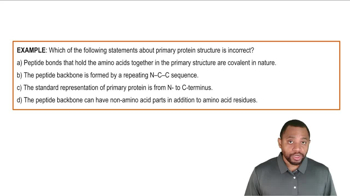
Primary Structure

The primary structure of a protein refers to its unique sequence of amino acids, which are linked together by peptide bonds. This sequence is determined by the genetic code and dictates the protein's overall shape and function. Any changes in this sequence can lead to significant alterations in the protein's properties.
추천 영상:
가이드 코스
1:11
Primary Protein Structure Example 1

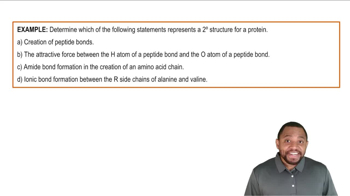
Secondary Structure

Secondary structure refers to the local folded structures that form within a protein due to hydrogen bonding between the backbone atoms. Common types of secondary structures include alpha helices and beta sheets. These structures are crucial for the protein's stability and play a significant role in its overall three-dimensional conformation.
추천 영상:
가이드 코스
1:24
Secondary Protein Structure Example 2

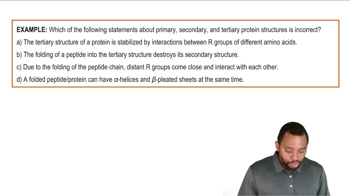
Protein Folding

Protein folding is the process by which a protein achieves its functional three-dimensional shape from its linear primary structure. The formation of secondary structures is a key step in this process, as it helps stabilize the protein and allows for further folding into tertiary and quaternary structures. Proper folding is essential for the protein's biological activity.
추천 영상:
가이드 코스
1:17
Tertiary Protein Structure Example 1