Ch.18 Metabolic Pathways and ATP Production
Timberlake - Chemistry: An Introduction to General, Organic, and Biological Chemistry 14th Edition
Timberlake14th EditionChemistry: An Introduction to General, Organic, and Biological ChemistryISBN: 9781292472249당신이 사용하는 게 아니라요?교과서 변경
18장, 문제 87

If there are no reactions in the citric acid cycle that use oxygen, O2, why does the cycle operate only in aerobic conditions?

검증된 단계별 안내
1
Understand the context: The citric acid cycle (also known as the Krebs cycle) is a central metabolic pathway that generates high-energy molecules like NADH and FADH₂, which are later used in the electron transport chain (ETC) to produce ATP.
Recognize the role of oxygen: While the citric acid cycle itself does not directly use oxygen (O₂), the NADH and FADH₂ produced in the cycle are oxidized in the ETC, which requires oxygen as the final electron acceptor.
Connect the dependency: If oxygen is not available, the ETC cannot function. This leads to a buildup of NADH and FADH₂, which are not converted back to their oxidized forms (NAD⁺ and FAD). These oxidized forms are essential for the citric acid cycle to continue operating.
Explain the aerobic condition: Without oxygen, the lack of NAD⁺ and FAD halts the citric acid cycle because these molecules are required to accept electrons during the cycle's reactions.
Summarize the relationship: Although the citric acid cycle does not directly use oxygen, it depends on the availability of NAD⁺ and FAD, which are regenerated in the oxygen-dependent ETC. Therefore, the cycle operates only under aerobic conditions.

비슷한 문제에 대한 검증된 영상 답변:

이 영상 해법은 위 문제에 도움이 된다고 튜터들이 추천한 것입니다.
영상 길이:
4m
도움이 되었나요?

주요 개념

질문에 올바르게 답하기 위해 반드시 이해해야 하는 핵심 개념들은 다음과 같습니다.

Citric Acid Cycle

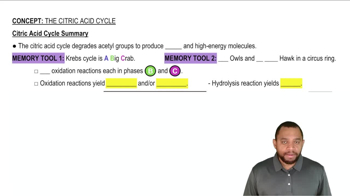
The citric acid cycle, also known as the Krebs cycle, is a series of enzymatic reactions that occur in the mitochondria, where acetyl-CoA is oxidized to produce energy carriers like NADH and FADH₂. Although it does not directly use oxygen, it is crucial for aerobic respiration, as it provides the reducing agents needed for the electron transport chain.
추천 영상:
가이드 코스
2:31
Citric Acid Cycle Summary Concept 12

Aerobic Conditions

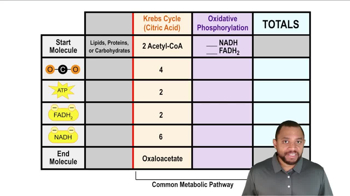
Aerobic conditions refer to environments where oxygen is present, allowing organisms to perform cellular respiration efficiently. In these conditions, the electron transport chain can operate, utilizing the NADH and FADH₂ produced in the citric acid cycle to generate ATP through oxidative phosphorylation, which is essential for energy production.
추천 영상:
가이드 코스
2:46
Aerobic Respiration Summary Concept 1

Electron Transport Chain

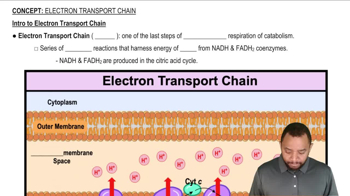
The electron transport chain (ETC) is a series of protein complexes located in the inner mitochondrial membrane that transfer electrons from NADH and FADH₂ to oxygen, forming water. This process creates a proton gradient that drives ATP synthesis. The citric acid cycle feeds into the ETC, linking its operation to the presence of oxygen, which is why the cycle is primarily active under aerobic conditions.
추천 영상:
가이드 코스
3:10
Intro to Electron Transport Chain Concept 1