Ch.18 Metabolic Pathways and ATP Production
Timberlake - Chemistry: An Introduction to General, Organic, and Biological Chemistry 14th Edition
Timberlake14th EditionChemistry: An Introduction to General, Organic, and Biological ChemistryISBN: 9781292472249당신이 사용하는 게 아니라요?교과서 변경
18장, 문제 83

When is pyruvate converted to lactate in the body?

검증된 단계별 안내
1
Understand the context: Pyruvate is a key intermediate in cellular metabolism, specifically in glycolysis, where glucose is broken down to produce energy in the form of ATP.
Recognize the conditions: Pyruvate is converted to lactate in the body under anaerobic conditions, meaning when oxygen levels are insufficient to support aerobic respiration.
Identify the process: In anaerobic conditions, cells rely on a process called lactic acid fermentation to regenerate NAD⁺ from NADH. This is crucial because NAD⁺ is required for glycolysis to continue producing ATP.
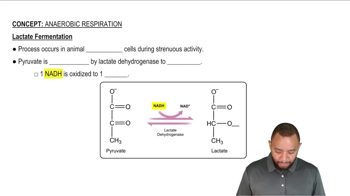
Describe the reaction: During lactic acid fermentation, the enzyme lactate dehydrogenase catalyzes the reduction of pyruvate to lactate, using NADH as a reducing agent and regenerating NAD⁺ in the process.
Relate to physiological scenarios: This conversion typically occurs in muscle cells during intense exercise when oxygen supply cannot meet the demand, leading to the accumulation of lactate and the sensation of muscle fatigue.

비슷한 문제에 대한 검증된 영상 답변:

이 영상 해법은 위 문제에 도움이 된다고 튜터들이 추천한 것입니다.
영상 길이:
2m
도움이 되었나요?

주요 개념

질문에 올바르게 답하기 위해 반드시 이해해야 하는 핵심 개념들은 다음과 같습니다.

Pyruvate Metabolism

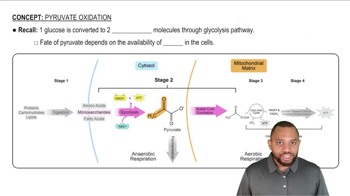
Pyruvate is a key intermediate in cellular metabolism, primarily produced during glycolysis. It can be further metabolized in the presence of oxygen through the citric acid cycle or converted to lactate in anaerobic conditions. Understanding the conditions under which pyruvate is converted to lactate is crucial for grasping energy production in cells.
추천 영상:
가이드 코스
1:49
Pyruvate Oxidation Concept 1

Lactate Fermentation

Lactate fermentation is an anaerobic process where pyruvate is reduced to lactate by the enzyme lactate dehydrogenase. This process occurs when oxygen levels are low, such as during intense exercise, allowing for continued ATP production despite the lack of aerobic respiration. It is essential for understanding how muscles cope with energy demands under low oxygen conditions.
추천 영상:
가이드 코스
1:14
Anaerobic Respiration Concept 3

Oxygen Debt

Oxygen debt refers to the amount of oxygen required to restore the body to its resting state after exercise. During intense physical activity, the body may rely on anaerobic metabolism, leading to lactate accumulation. Recognizing the concept of oxygen debt helps explain why lactate is produced and how the body recovers post-exercise.
추천 영상:
가이드 코스
01:32
Balancing Chemical Equations (Simplified) Concept 1