Ch.18 Metabolic Pathways and ATP Production
Timberlake - Chemistry: An Introduction to General, Organic, and Biological Chemistry 14th Edition
Timberlake14th EditionChemistry: An Introduction to General, Organic, and Biological ChemistryISBN: 9781292472249당신이 사용하는 게 아니라요?교과서 변경
18장, 문제 98d

Which of the following molecules will produce the most ATP per mole?
d. lauric acid (C12) or palmitic acid (C16)

검증된 단계별 안내
1
Step 1: Understand the problem. The question asks which molecule, lauric acid (C₁₂) or palmitic acid (C₁₆), will produce the most ATP per mole. This involves comparing the energy yield of these two fatty acids during their metabolism, specifically through β-oxidation and the citric acid cycle.
Step 2: Recall the process of β-oxidation. Each cycle of β-oxidation shortens the fatty acid chain by two carbons, producing 1 FADH₂, 1 NADH, and 1 acetyl-CoA. The number of β-oxidation cycles is determined by the number of carbons in the fatty acid minus 2, divided by 2. For lauric acid (C₁₂), there are 5 cycles, and for palmitic acid (C₁₆), there are 7 cycles.
Step 3: Calculate the total number of acetyl-CoA molecules produced. Each fatty acid produces acetyl-CoA molecules equal to the number of carbons divided by 2. Lauric acid (C₁₂) produces 6 acetyl-CoA molecules, while palmitic acid (C₁₆) produces 8 acetyl-CoA molecules.
Step 4: Determine the ATP yield from each product. Each FADH₂ yields approximately 1.5 ATP, each NADH yields approximately 2.5 ATP, and each acetyl-CoA entering the citric acid cycle yields approximately 10 ATP. Multiply these values by the number of FADH₂, NADH, and acetyl-CoA molecules produced during β-oxidation and the citric acid cycle for each fatty acid.
Step 5: Compare the total ATP yield. Since palmitic acid (C₁₆) has more carbons than lauric acid (C₁₂), it undergoes more β-oxidation cycles and produces more acetyl-CoA, resulting in a higher total ATP yield per mole. Therefore, palmitic acid will produce the most ATP per mole.

비슷한 문제에 대한 검증된 영상 답변:

이 영상 해법은 위 문제에 도움이 된다고 튜터들이 추천한 것입니다.
영상 길이:
1m

주요 개념

질문에 올바르게 답하기 위해 반드시 이해해야 하는 핵심 개념들은 다음과 같습니다.

Beta-Oxidation

Beta-oxidation is the metabolic process by which fatty acids are broken down in the mitochondria to generate acetyl-CoA, which then enters the citric acid cycle. Each cycle of beta-oxidation shortens the fatty acid chain by two carbon atoms and produces NADH and FADH2, which are crucial for ATP production in the electron transport chain.
추천 영상:
가이드 코스
02:32
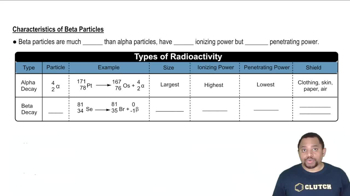
Characteristics of Beta Particles

ATP Yield from Fatty Acids

The ATP yield from fatty acids depends on their carbon chain length. Longer fatty acids, such as palmitic acid (C₁₆), produce more acetyl-CoA and thus more ATP through subsequent metabolic pathways compared to shorter fatty acids like lauric acid (C₁₂). This is because each acetyl-CoA can generate multiple ATP molecules during cellular respiration.
추천 영상:
가이드 코스
4:19
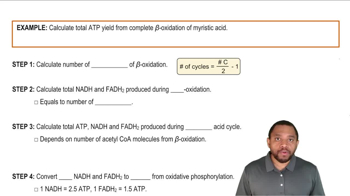
Total Energy from Fatty Acids Example 1

Energy Density of Fatty Acids

Fatty acids are energy-dense molecules, providing more energy per gram than carbohydrates or proteins. This is due to their long hydrocarbon chains, which contain many carbon-hydrogen bonds that release energy when oxidized. Understanding the energy density helps in comparing the ATP yield of different fatty acids based on their structure.
추천 영상:
가이드 코스
3:08
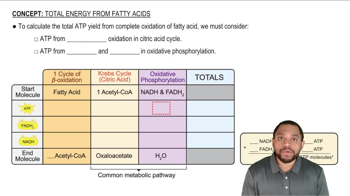
Total Energy from Fatty Acids Concept 1