Why do catalysts not alter the amounts of reactants and products present at equilibrium?
검증된 단계별 안내
1
Understand that a catalyst is a substance that increases the rate of a chemical reaction without being consumed in the process.
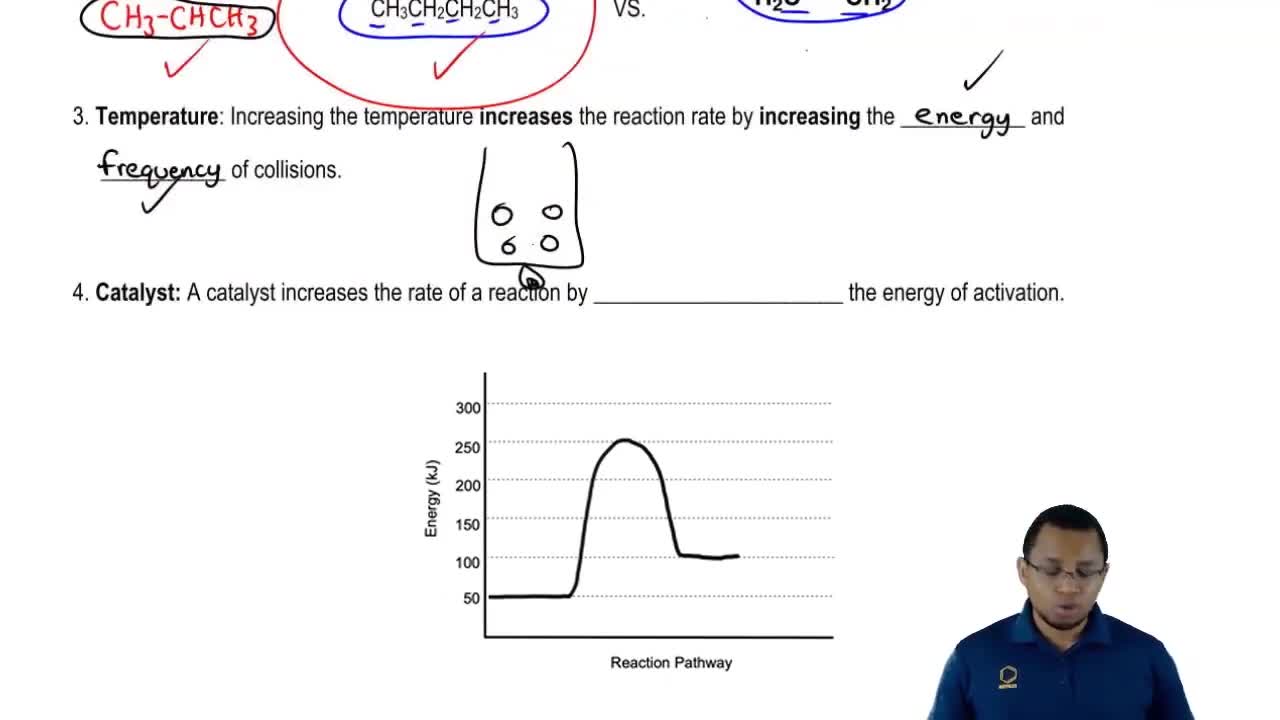
Recognize that catalysts work by providing an alternative reaction pathway with a lower activation energy, which speeds up both the forward and reverse reactions equally.
Recall that equilibrium is a state where the rates of the forward and reverse reactions are equal, resulting in constant concentrations of reactants and products.
Note that since a catalyst affects both the forward and reverse reactions equally, it does not change the position of equilibrium; it only helps the system reach equilibrium faster.
Conclude that because the position of equilibrium is determined by the relative energies of reactants and products, and not by the pathway taken to reach equilibrium, a catalyst does not alter the amounts of reactants and products present at equilibrium.
비슷한 문제에 대한 검증된 영상 답변:
이 영상 해법은 위 문제에 도움이 된다고 튜터들이 추천한 것입니다.
영상 길이:
1m
영상 재생:
0 댓글
주요 개념
질문에 올바르게 답하기 위해 반드시 이해해야 하는 핵심 개념들은 다음과 같습니다.
Chemical Equilibrium
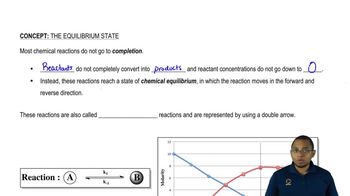
Chemical equilibrium occurs when the rates of the forward and reverse reactions in a chemical process are equal, resulting in constant concentrations of reactants and products. At this state, the system is dynamic, meaning that reactions continue to occur, but there is no net change in the amounts of substances involved.
Catalysts are substances that increase the rate of a chemical reaction without being consumed in the process. They work by lowering the activation energy required for the reaction to occur, allowing reactants to convert to products more efficiently. However, they do not affect the position of equilibrium or the final concentrations of reactants and products.
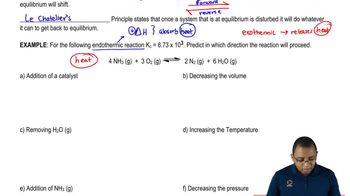
Le Chatelier's Principle states that if a system at equilibrium is subjected to a change in concentration, temperature, or pressure, the system will adjust to counteract that change and restore a new equilibrium. Since catalysts do not change the energy levels of reactants or products, they do not shift the equilibrium position, thus leaving the amounts of reactants and products unchanged.

 1:11분
1:11분 검증된 단계별 안내
 03:42
03:42