What effect do the listed changes have on the position of the equilibrium in the reaction of carbon with hydrogen?
C(s) + 2 H2(g) ⇌ CH4(g) ∆H = -18 kcal/mol (-75kJ/mol)
Allowing CH4 to escape continuously from the reaction vessel
검증된 단계별 안내
1
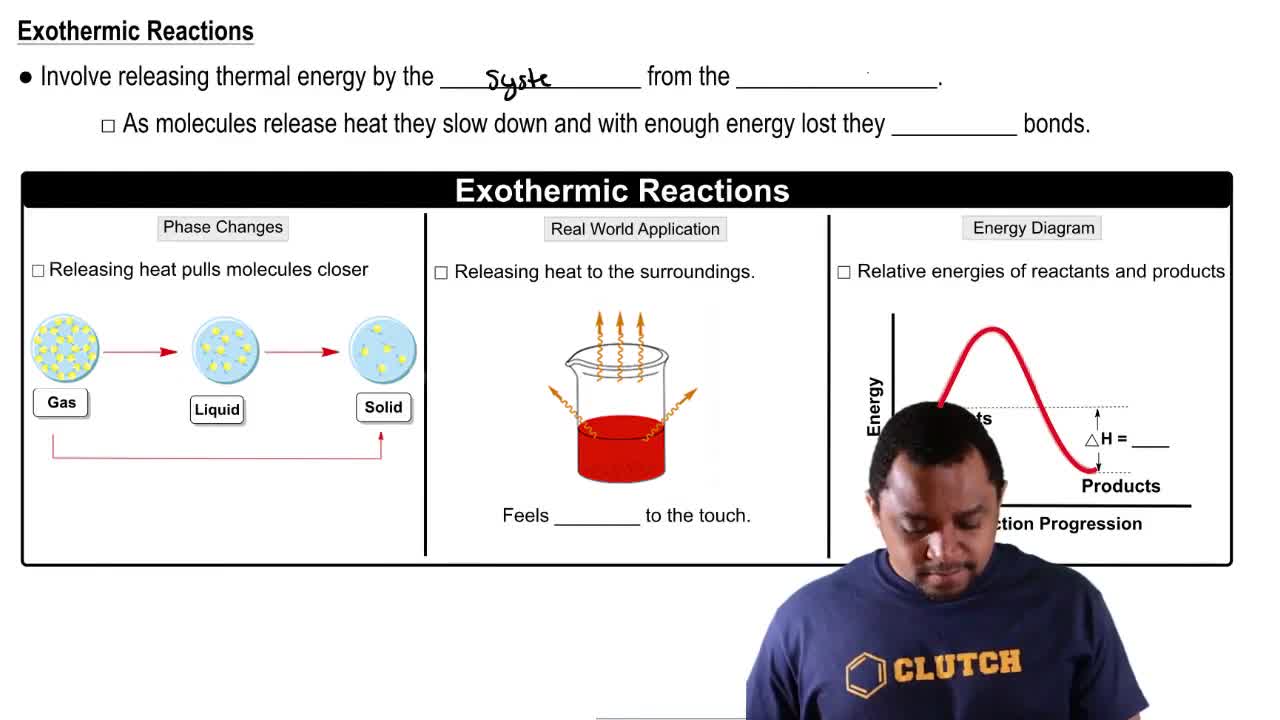
Identify the type of reaction: The given reaction is an exothermic reaction, as indicated by the negative \( \Delta H \) value.
Understand the concept of equilibrium: In a chemical equilibrium, the rate of the forward reaction equals the rate of the reverse reaction.
Apply Le Chatelier's Principle: This principle states that if a dynamic equilibrium is disturbed by changing the conditions, the position of equilibrium shifts to counteract the change.
Consider the effect of removing a product: Allowing \( \text{CH}_4 \) to escape continuously reduces its concentration in the reaction vessel.
Predict the shift in equilibrium: According to Le Chatelier's Principle, the equilibrium will shift to the right to produce more \( \text{CH}_4 \) to replace what is being removed.
비슷한 문제에 대한 검증된 영상 답변:
이 영상 해법은 위 문제에 도움이 된다고 튜터들이 추천한 것입니다.
영상 길이:
1m
영상 재생:
0 댓글
주요 개념
질문에 올바르게 답하기 위해 반드시 이해해야 하는 핵심 개념들은 다음과 같습니다.
Le Chatelier's Principle
Le Chatelier's Principle states that if a dynamic equilibrium is disturbed by changing the conditions, the position of equilibrium shifts to counteract the change. In this case, allowing CH4 to escape continuously reduces its concentration, prompting the equilibrium to shift to the right to produce more CH4, thereby attempting to restore balance.
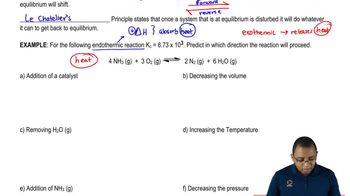
The following is an endothermic reaction where Kc = 6.73 x 10³.For each of the choices below predict in which direction the reaction will proceed
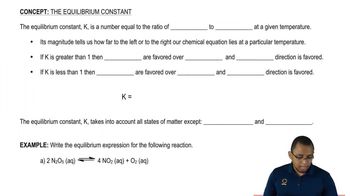
Equilibrium Constant (K)
The equilibrium constant (K) quantifies the ratio of the concentrations of products to reactants at equilibrium for a given reaction at a specific temperature. For the reaction C(s) + 2 H2(g) ⇌ CH4(g), the equilibrium constant will change if the concentration of CH4 decreases due to its escape, affecting the overall position of the equilibrium.
The reaction given is exothermic, as indicated by the negative ΔH value. In exothermic reactions, heat is released when products are formed. If the system loses CH4, the equilibrium will shift to the right to produce more CH4, which also means that the system will release heat, further influencing the reaction dynamics and equilibrium position.