The vaporization of Br2 from the liquid to the gas state requires 7.4 kcal/mol (31.0 kJ/mol).
What is the sign of ∆H for this process? Write a reaction showing heat as a product or reactant.
검증된 단계별 안내
1
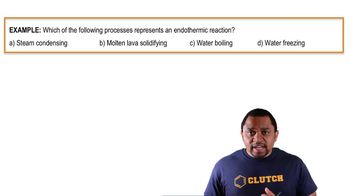
Identify the process: The vaporization of Br2 from liquid to gas is an endothermic process.
Understand the sign of \( \Delta H \): In an endothermic process, heat is absorbed, so \( \Delta H \) is positive.
Write the chemical equation for the vaporization of Br2: \( \text{Br}_2(l) \rightarrow \text{Br}_2(g) \).
Include heat in the equation: Since the process is endothermic, heat is a reactant. The equation becomes \( \text{Br}_2(l) + \text{heat} \rightarrow \text{Br}_2(g) \).
Conclude: The sign of \( \Delta H \) is positive, indicating that heat is absorbed during the vaporization of Br2.
비슷한 문제에 대한 검증된 영상 답변:
이 영상 해법은 위 문제에 도움이 된다고 튜터들이 추천한 것입니다.
영상 길이:
51s
영상 재생:
0 댓글
주요 개념
질문에 올바르게 답하기 위해 반드시 이해해야 하는 핵심 개념들은 다음과 같습니다.
Enthalpy Change (∆H)
Enthalpy change (∆H) is a measure of the heat content of a system during a chemical reaction or phase change. It indicates whether a process absorbs heat (endothermic, ∆H > 0) or releases heat (exothermic, ∆H < 0). In the case of vaporization, heat is absorbed to convert a liquid into a gas, resulting in a positive ∆H.
An endothermic process is one that requires the absorption of heat from the surroundings. During the vaporization of bromine (Br2), energy is needed to overcome intermolecular forces in the liquid state, allowing the molecules to escape into the gas phase. This absorption of heat is reflected in the positive value of ∆H for the vaporization process.
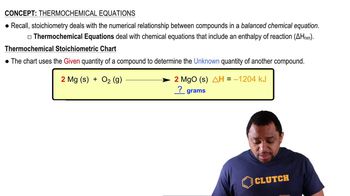
A thermochemical equation represents a chemical reaction along with the associated enthalpy change. In this case, the vaporization of Br2 can be written as: Br2(l) → Br2(g) + 7.4 kcal. This equation shows that heat is absorbed during the transition from liquid to gas, emphasizing the endothermic nature of the process.

 0:51분
0:51분 검증된 단계별 안내
 01:17
01:17