Classify each of the following as exothermic or endothermic:
a. CH₄(g) + 2O₂(g) →∆ CO₂(g) + 2H₂O(g) + 802kJ
검증된 단계별 안내
1
Identify the type of reaction: The reaction given is a combustion reaction where methane (CH₄) is reacting with oxygen (O₂) to produce carbon dioxide (CO₂) and water (H₂O).
Look at the energy term: The reaction releases 802 kJ of energy, which is indicated by the '+ 802 kJ' on the product side of the equation.
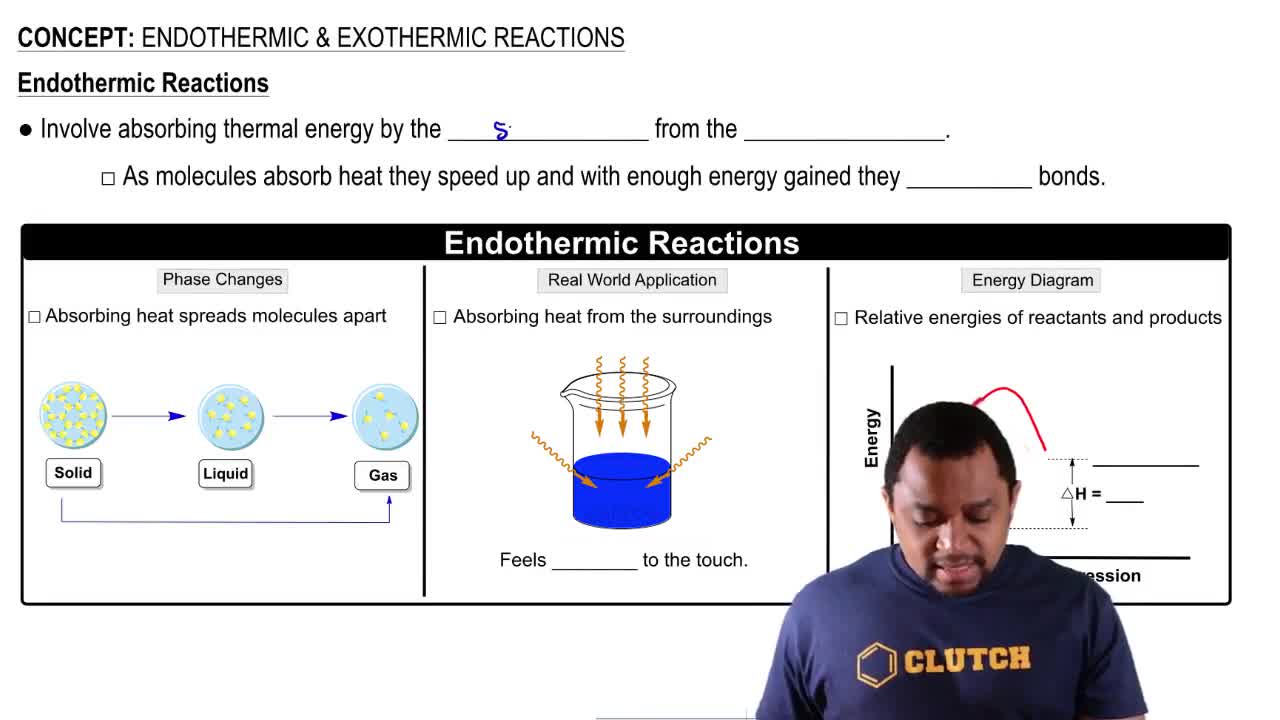
Understand the energy flow: In chemical reactions, if energy is released to the surroundings, the reaction is exothermic. If energy is absorbed from the surroundings, the reaction is endothermic.
Determine the classification: Since the reaction releases energy (802 kJ), it is classified as exothermic.
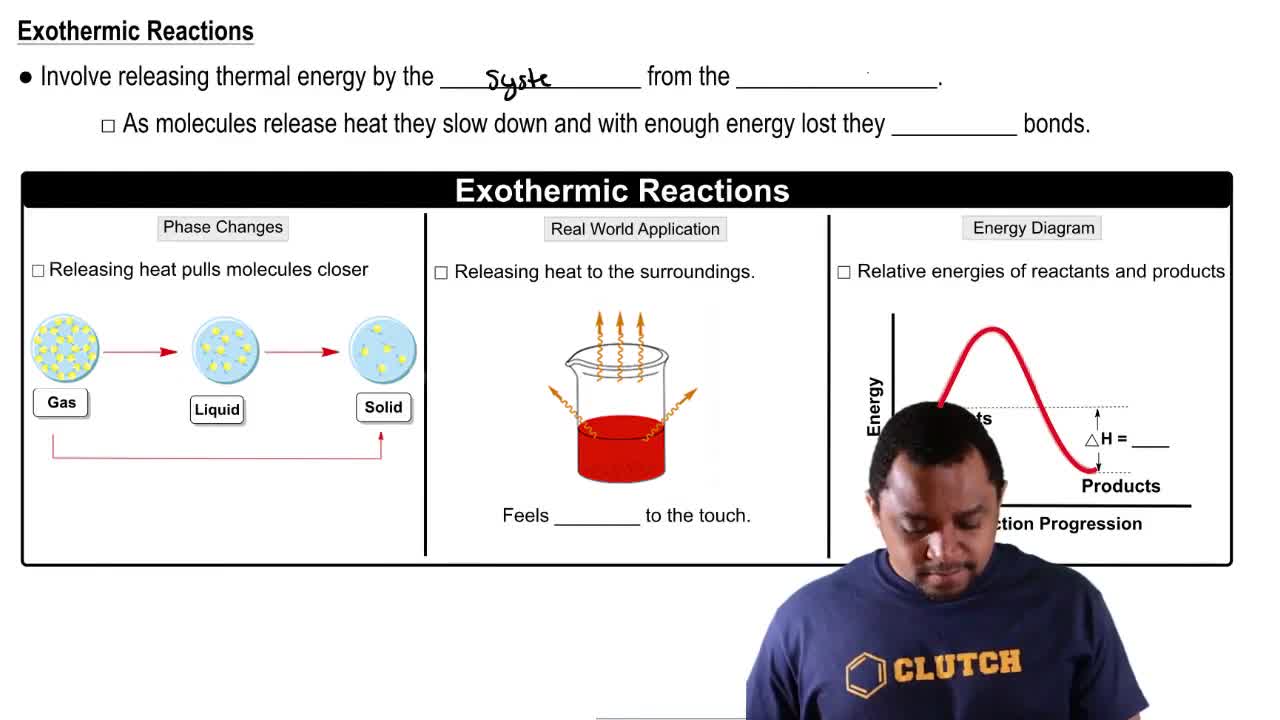
Conclude with the definition: An exothermic reaction is one that releases energy, usually in the form of heat, to the surroundings.
비슷한 문제에 대한 검증된 영상 답변:
이 영상 해법은 위 문제에 도움이 된다고 튜터들이 추천한 것입니다.
영상 길이:
3m
영상 재생:
0 댓글
주요 개념
질문에 올바르게 답하기 위해 반드시 이해해야 하는 핵심 개념들은 다음과 같습니다.
Exothermic Reactions
Exothermic reactions are chemical processes that release energy, usually in the form of heat, to the surroundings. This energy release occurs because the total energy of the products is lower than that of the reactants. A common example is the combustion of fuels, where energy is released as heat and light.
Endothermic reactions absorb energy from their surroundings, resulting in a decrease in temperature of the immediate environment. In these reactions, the energy of the products is higher than that of the reactants. Photosynthesis is a classic example, where plants absorb sunlight to convert carbon dioxide and water into glucose.
Enthalpy change (ΔH) is a measure of the heat content of a system during a chemical reaction at constant pressure. A negative ΔH indicates an exothermic reaction, while a positive ΔH signifies an endothermic reaction. In the given reaction, the release of 802 kJ suggests that it is exothermic, as energy is being released to the surroundings.

 3:34분
3:34분 검증된 단계별 안내
 02:38
02:38