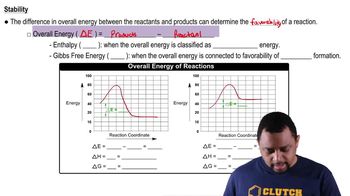
The heat of reaction, also known as enthalpy change (ΔH), measures the heat absorbed or released during a chemical reaction at constant pressure.
To understand this concept, consider whether the reaction is exothermic or endothermic. An exothermic reaction releases heat, resulting in a negative ΔH, while an endothermic reaction absorbs heat, leading to a positive ΔH.
The heat of reaction can be determined experimentally using a calorimeter, which measures the temperature change of the surroundings as the reaction occurs.
In a chemical equation, the heat of reaction is often represented as a term on the product side for exothermic reactions or on the reactant side for endothermic reactions.
Understanding the heat of reaction is crucial for predicting the energy changes in chemical processes and for applications in thermochemistry.
비슷한 문제에 대한 검증된 영상 답변:
이 영상 해법은 위 문제에 도움이 된다고 튜터들이 추천한 것입니다.
영상 길이:
2m
영상 재생:
0 댓글
주요 개념
질문에 올바르게 답하기 위해 반드시 이해해야 하는 핵심 개념들은 다음과 같습니다.
Heat of Reaction
The heat of reaction, also known as enthalpy change, refers to the amount of heat absorbed or released during a chemical reaction at constant pressure. It indicates whether a reaction is exothermic (releases heat) or endothermic (absorbs heat). This measurement is crucial for understanding the energy dynamics of chemical processes.
Enthalpy is a thermodynamic property that represents the total heat content of a system. It is defined as the sum of the internal energy and the product of pressure and volume. Changes in enthalpy during a reaction provide insight into the energy changes that occur, which is essential for calculating the heat of reaction.
Calorimetry is the science of measuring the heat of chemical reactions or physical changes. It involves using a calorimeter, an instrument that can measure the heat transfer associated with a reaction. By determining the heat exchanged, calorimetry allows chemists to quantify the heat of reaction and understand the energy changes involved.

 2:57분
2:57분 검증된 단계별 안내

 00:44
00:44