Sensitivity Analysis: 동영상 및 연습문제
Sensitivity Analysis in CVP analysis examines how changes in key assumptions affect a business’s results, especially the break-even point. The main inputs considered are sales price, variable cost, and fixed cost. When sales price changes, managers must recalculate both the contribution margin per unit and the contribution margin ratio, because contribution margin is based on sales price minus variable cost.
The core relationships are \(CM\\ \text{per unit}=\text{sales price per unit}-\text{variable cost per unit}\) , \(CM\\ \text{ratio}=\frac{CM\\ \text{per unit}}{\text{sales price}}\) , and \(\text{break-even point in units}=\frac{\text{fixed cost}}{CM\\ \text{per unit}}\) .
The pattern is consistent: if sales price rises, break-even units fall; if sales price falls, break-even units rise. If variable cost rises, contribution margin shrinks and break-even units increase; if variable cost falls, break-even units decrease. A change in fixed cost is the simplest case because it affects only the break-even point, not contribution margin.
Sensitivity Analysis: Changing Price

Sensitivity Analysis: Changing Price
Whenever a business lowers their sales price, we expect that their break-even point after the change will be:
Higher than the original break-even point.
The same as the original break-even point.
Lower than the original break-even point.
Fill in the blanks. D- Education is a private school that has \$1,000,000 in fixed costs per year and spends \$5,000 per student in variable costs. If their tuition is \$10,000 per year, their breakeven point would be ____________ and, if they raised their tuition to \$15,000 per year, their breakeven point would be ____________.
200 students; 200 students.
400 students; 200 students.
200 students; 100 students.
100 students; 50 students.
Sensitivity Analysis: Changing Variable Costs
Sensitivity Analysis: Changing Variable Costs
Whenever a business’ variable costs rise, we expect that their break-even point after the change will be:
Higher than the original break-even point
The same as the original break-even point
Lower than the original break-even point
Fill in the blank. D- Education has \$1,000,000 in fixed costs per year and spends \$5,000 per student in variable costs. Their tuition is \$10,000 per year. If their variable costs increased to \$7,500 per student, their breakeven point would be ____________.
100 students
200 students
400 students
800 students
Sensitivity Analysis: Changing Fixed Costs
Sensitivity Analysis: Changing Fixed Costs
Whenever a business’ fixed costs rise, we expect that their break-even point after the change will be:
Higher than the original break-even point.
The same as the original break-even point.
Lower than the original break-even point.
Fill in the blanks. Super Sweet Candy produces licorice at the costs given in the table. Their break-even point is ____________ and would change to ____________ if their fixed costs rose to \$15,000.
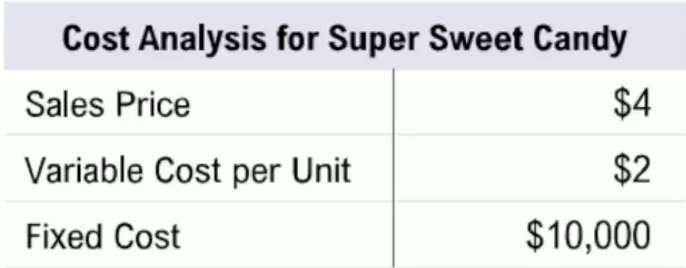
5,000 units; 7,500 units.
5,000 units; 10,000 units.
10,000 units; 7,500 units.
10,000 units; 10,000 units.
학생들이 이 주제에 대해 묻는 질문은 다음과 같습니다:
Sensitivity analysis in Cost-Volume-Profit (CVP) analysis examines how changes in key business variables like sales price, variable cost, and fixed cost affect outcomes such as the break-even point. It is important because it helps managers understand the impact of different scenarios on profitability and cost coverage. For example, if the sales price decreases, the contribution margin per unit shrinks, causing the break-even point to increase, meaning more units must be sold to cover costs. Conversely, if variable costs rise, the contribution margin decreases, also increasing the break-even point. Sensitivity analysis allows managers to anticipate how changes in market conditions or costs affect their business and make informed pricing, cost control, and production decisions.
When the sales price changes, it directly affects the contribution margin per unit and the break-even point. The contribution margin per unit is calculated as . If the sales price decreases, the contribution margin per unit decreases because less money is earned per unit after covering variable costs. This leads to a higher break-even point, calculated as , meaning more units must be sold to cover fixed costs. Conversely, if the sales price increases, the contribution margin per unit increases, and the break-even point decreases, requiring fewer units to break even. This relationship helps managers decide optimal pricing strategies.
An increase in variable costs reduces the contribution margin per unit because the formula is . When variable costs rise, less money remains to cover fixed costs, so the contribution margin shrinks. This causes the break-even point, calculated as , to increase. In other words, the business must sell more units to cover all costs and break even. This insight is crucial for managers to control costs and adjust pricing or production levels accordingly.
Changes in fixed costs affect only the break-even point and not the contribution margin per unit or ratio. The break-even point is calculated as . If fixed costs increase, the break-even point rises, meaning the business must sell more units to cover the higher fixed costs. Conversely, if fixed costs decrease, the break-even point falls, requiring fewer units to break even. Since fixed costs do not affect the contribution margin, this is the simplest sensitivity analysis to perform. Understanding this helps managers plan for changes in overhead or fixed expenses.
The contribution margin ratio is the contribution margin per unit divided by the sales price, expressed as . When sales price or variable costs change, the contribution margin per unit changes because it is calculated as sales price minus variable cost. Since the ratio depends on both the contribution margin and sales price, any change in these inputs requires recalculating the ratio. This ratio is important because it shows the percentage of each sales dollar available to cover fixed costs and profit, helping managers assess profitability under different scenarios.

