Budgeted Income Statement: 동영상 및 연습문제
A Budgeted Income Statement estimates the income a company expects to earn if it follows the master budget. It mirrors a regular income statement for each period being analyzed and helps compare planned results with actual performance. The statement is built from other budget schedules, especially the sales budget, operating expenses budget, and cash budget.
To prepare it, begin with budgeted sales revenue from the sales budget. Then compute cost of goods sold using \( \text{Cost of Goods Sold} = \text{Units Sold} \times \text{Unit Product Cost} \) . The unit product cost comes from the finished goods inventory information. Subtract cost of goods sold from sales revenue to get gross profit, then subtract operating expenses to find net operating income.
The final step is to subtract interest expense from the cash budget to arrive at net income. Only interest expense is included here, not debt repayments, because the focus is on the cost of operating and financing the business rather than paying back principal.
Budgeted Income Statement

Budgeted Income Statement
A furniture maker has set the following expected operating data for the month of May:
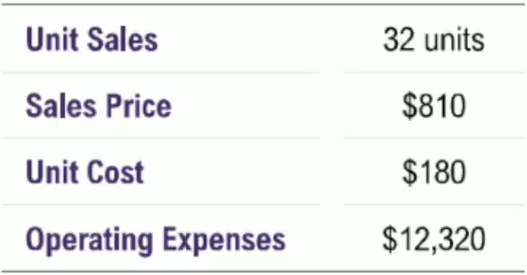
Calculate the Budgeted Gross Profit and Budgeted Net Income at the end of May?
Budgeted Gross Profit = \$20,160; Budgeted Net Income = \$7,840
Budgeted Gross Profit = \$25,920; Budgeted Net Income = \$5,760
Budgeted Gross Profit = \$28,350; Budgeted Net Income = \$6,300
Budgeted Gross Profit = \$22,050; Budgeted Net Income = \$9,730
학생들이 이 주제에 대해 묻는 질문은 다음과 같습니다:
A budgeted income statement is a financial document that estimates the income a company expects to earn if it follows its master budget. It mirrors a regular income statement but is prepared for each period being analyzed, such as quarterly or annually. This statement is important because it helps managers and stakeholders compare planned financial results with actual performance at the end of the period. By doing so, it provides insight into whether the company is meeting its financial goals and helps identify areas that may need adjustment. It is built using information from other budgets like the sales budget, operating expenses budget, and cash budget, making it a comprehensive tool for financial planning and control.
To calculate the cost of goods sold (COGS) for a budgeted income statement, you use the formula: . The number of units sold is obtained from the sales budget, which estimates how many units the company expects to sell in the period. The unit product cost is derived from the finished goods inventory information, representing the cost to produce one unit. Multiplying these two values gives the total cost of goods sold, which is then subtracted from sales revenue to calculate gross profit on the budgeted income statement.
To prepare a budgeted income statement, you need several key components: (1) Sales revenue, which comes from the sales budget and represents the expected income from sales; (2) Cost of goods sold (COGS), calculated by multiplying the expected units sold by the unit product cost from the finished goods inventory; (3) Operating expenses, obtained from the operating expenses budget, which includes costs related to running the business; and (4) Interest expense, taken from the cash budget, representing the cost of financing but excluding debt repayments. These components are combined to estimate net income, providing a forecast of the company’s profitability if the budget is followed.
Debt repayments are excluded from the interest expense in the budgeted income statement because the focus is on the costs associated with operating and financing the business, not on repaying the principal amount of debt. Interest expense represents the cost of borrowing money and is an operating cost that affects net income. In contrast, debt repayments are cash outflows that reduce liabilities but do not affect the income statement directly. Including only interest expense ensures the budgeted income statement accurately reflects the company’s profitability without mixing in financing principal repayments.
A budgeted income statement helps a company evaluate its financial performance by providing a forecast of expected income based on planned sales, costs, and expenses. After the period ends, the company can compare actual results to the budgeted figures to see if it met, exceeded, or fell short of its financial goals. This comparison highlights areas where the company performed well or where adjustments are needed, such as controlling costs or increasing sales. It also aids in decision-making and strategic planning by offering a clear financial target to strive for throughout the period.

