Ch. 12 - Characterizing and Classifying Eukaryotes
Bauman - Microbiology with Diseases by Taxonomy 6th Edition
Bauman6th EditionMicrobiology with Diseases by TaxonomyISBN: 9780134832302당신이 사용하는 게 아니라요?교과서 변경
12장, 문제 7

Name two ways that slime molds differ from true fungi.

검증된 단계별 안내
1
Understand that slime molds and true fungi are both eukaryotic organisms but belong to different biological groups with distinct characteristics.
Identify the first key difference: slime molds exhibit a unique life cycle stage where they exist as a motile, amoeba-like plasmodium that can move and engulf food particles, whereas true fungi do not have a motile stage and typically grow as hyphae or yeast cells.
Identify the second key difference: slime molds obtain nutrients primarily through phagocytosis (engulfing food particles), while true fungi absorb nutrients by secreting enzymes and absorbing the digested material externally.
Summarize that slime molds differ from true fungi in their mode of movement and nutrient acquisition methods.
Optionally, note that slime molds are often classified under the kingdom Protista, whereas true fungi belong to the kingdom Fungi, highlighting their taxonomic distinction.

비슷한 문제에 대한 검증된 영상 답변:

이 영상 해법은 위 문제에 도움이 된다고 튜터들이 추천한 것입니다.
영상 길이:
1m
도움이 되었나요?

주요 개념

질문에 올바르게 답하기 위해 반드시 이해해야 하는 핵심 개념들은 다음과 같습니다.

Slime Mold Classification

Slime molds are protists, not true fungi, meaning they belong to a different kingdom. Unlike fungi, slime molds exhibit characteristics of both amoebas and fungi, such as moving like amoebas during part of their life cycle and producing spores like fungi.
추천 영상:
가이드 코스
01:53
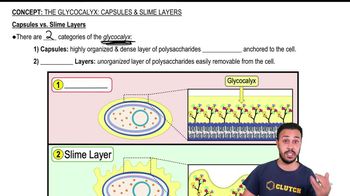
Capsules vs. Slime Layers

Life Cycle and Movement

Slime molds have a unique life cycle that includes a motile, amoeboid stage where they can move and engulf food particles, unlike true fungi which are generally non-motile and absorb nutrients through hyphae.
추천 영상:
가이드 코스
02:43
Prokaryotic Flagellar Movement

Cellular Structure and Organization

True fungi have cell walls made of chitin and grow as multicellular hyphae or unicellular yeasts, while slime molds lack chitin in their cell walls and often exist as a multinucleate, single-celled mass called a plasmodium during their feeding stage.
추천 영상:
가이드 코스
05:22
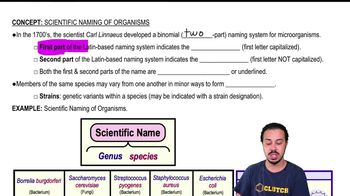
Scientific Naming of Organisms